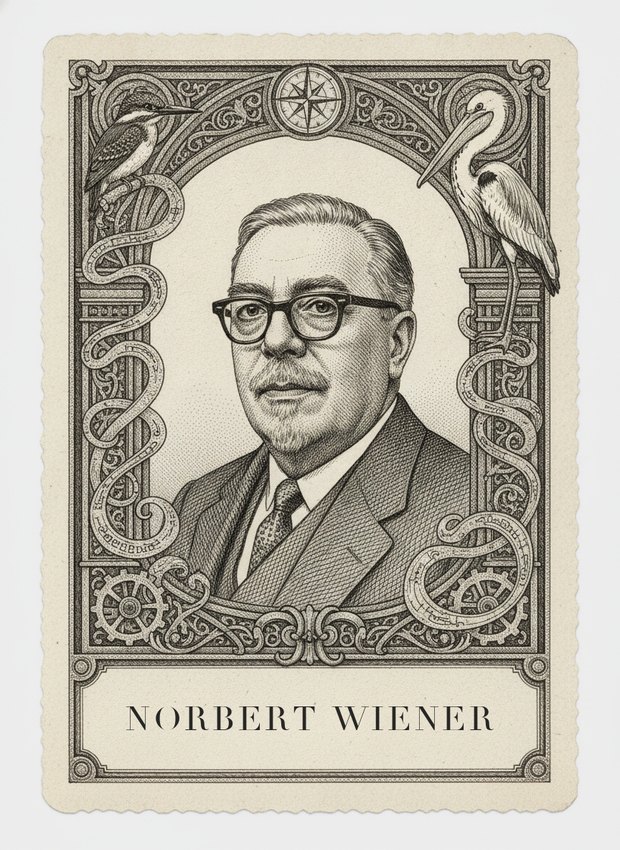
Norbert Wiener
Cybernetics; optimal filtering; feedback control
Strongest on
In the mind map
The same ideas, as concepts rather than history — in John's ML knowledge map.
Life and career
Norbert Wiener's childhood was an experiment, and he knew it. Born in Columbia, Missouri, in 1894 to Leo Wiener — a Harvard professor of Slavic languages, a self-taught polymath, and an aggressive believer in the malleability of young minds — Norbert was homeschooled under relentless paternal drilling, entered Tufts at eleven, graduated at fourteen, and took a Harvard PhD in mathematical logic at eighteen. He spent the rest of his life describing the cost. His two memoirs, *Ex-Prodigy* and *I Am a Mathematician*, are unusually frank about the anxiety and social isolation the regime produced, and they remain among the more honest documents a great mathematician has left about his own formation.
After the doctorate he went to Europe on a fellowship, studying with Bertrand Russell and G. H. Hardy at Cambridge and with Hilbert and Landau at Göttingen. Russell pushed him toward physics; the encounter with Einstein's and Bohr's work, and with Lebesgue's measure theory, set up the problem that made his mathematical reputation. He served briefly at the Aberdeen Proving Ground computing ballistics tables during the First World War, and in 1919 joined MIT, then a competent engineering school rather than a research power. He stayed for the rest of his career and helped make it one.
The 1920s and 1930s were Wiener's pure-mathematics decades: Brownian motion, generalized harmonic analysis, Tauberian theorems, the Paley–Wiener theory. He was, by any measure, one of the leading analysts in the world. Then the Second World War redirected him, permanently. Working on the fire-control problem — how to aim anti-aircraft guns at a maneuvering aircraft, given noisy radar tracks and a shell with several seconds of flight time — Wiener had to build a theory of prediction and filtering for stationary stochastic processes. The classified 1942 report on that work, bound in yellow and nicknamed "the yellow peril" by the engineers who struggled through it, was published openly in 1949.
The fire-control problem also gave him something more general. A gunner tracking a plane, a servomechanism correcting its error, a person reaching for a glass, a body regulating its temperature — all are systems that sense a discrepancy from a goal and act to reduce it, and all can be destabilized in similar ways by too much gain or too much delay. Wiener, together with the physiologist Arturo Rosenblueth and the engineer Julian Bigelow, argued that this common structure — feedback — deserved a science of its own. In 1948 he named it: *Cybernetics: or Control and Communication in the Animal and the Machine*, from the Greek for steersman. The book was a genuine popular phenomenon, and it seeded a decade of interdisciplinary ferment through the Macy Conferences, where mathematicians, neurophysiologists, anthropologists, and psychiatrists tried to build a unified science of purposive systems.
Wiener's later years were marked by his refusal to participate in military research. Having seen what his war work enabled, he publicly declined further weapons-related contracts, wrote against the militarization of science, and turned to the social consequences of automation. *The Human Use of Human Beings* (1950) and his 1960 *Science* essay "Some Moral and Technical Consequences of Automation" argued that automatic machinery would displace labor faster than institutions could absorb, and — more presciently — that a machine which pursues a goal faster than we can inspect or revise it had better be given the goal we actually want. He wrote about the sorcerer's apprentice and about the monkey's paw as parables for exactly this. He died in Stockholm in 1964. His relations with colleagues, notably with von Neumann and with the McCulloch group, frayed badly in his later years; the cybernetics movement he founded dispersed into control theory, AI, systems biology, and management science without him.
Key contributions
**The Wiener process.** In work beginning around 1921, Wiener gave the first rigorous mathematical construction of Brownian motion — a probability measure on the space of continuous paths, now called Wiener measure, under which the coordinate process has independent stationary Gaussian increments and almost surely continuous, almost surely nowhere-differentiable sample paths. This is the foundational object of continuous-time stochastic processes. Every diffusion model, every SDE, every stochastic-differential-equation-based generative model in contemporary ML is built over a Wiener process. His related work on stochastic integration (the Wiener integral, and the Wiener–Itô chaos expansion) is the direct ancestor of Itô calculus.
**Wiener filtering and prediction.** Given a signal $s(t)$ corrupted by additive noise $n(t)$, both modelled as stationary stochastic processes with known spectra, what linear time-invariant filter minimizes the mean-squared error of an estimate of $s(t+\alpha)$? Wiener's answer, developed for fire control and published in *Extrapolation, Interpolation, and Smoothing of Stationary Time Series* (1949), is the optimal filter whose transfer function is built from the ratio of signal to signal-plus-noise spectral densities; for the causal (realizable) case it requires the Wiener–Hopf technique of spectral factorization to enforce that the filter uses only the past. Kolmogorov derived the discrete-time version independently in the Soviet Union, hence "Wiener–Kolmogorov filtering." The Kalman filter a decade later is the state-space, recursive, non-stationary successor — but the criterion, minimum mean-squared linear estimation, is Wiener's.
**Generalized harmonic analysis and Tauberian theorems.** Wiener extended Fourier analysis to functions that are not integrable but have finite average power, defining the autocorrelation and the power spectrum for such signals — the mathematical foundation of spectral analysis of time series. His Tauberian theorem, for which he won the Bôcher Prize, gave conditions under which averaged asymptotic behavior implies pointwise asymptotic behavior, and is used well outside its original context.
**Cybernetics.** The technical content is the claim that feedback control, information transmission, and stability analysis are the same mathematics whether the substrate is neural, mechanical, or economic; that negative feedback explains goal-seeking behavior without teleology; and that oscillation and hunting in servomechanisms are formally analogous to certain neurological tremors. Wiener also made an early, explicit connection between entropy in statistical mechanics and information in communication — arrived at independently of and roughly concurrently with Shannon, though Shannon's formulation proved the more usable one.
**The alignment warning.** The 1960 *Science* essay states, in terms a modern AI-safety researcher would recognize immediately, that if we build a machine whose operation we cannot effectively interfere with once started, we had better be quite sure the purpose we put into it is the purpose we really desire. Wiener's framing — that the danger scales with the system's speed and power relative to our ability to inspect and correct it — is the corrigibility problem stated in 1960.
In battle
Wiener's profile is the most lopsided of the mid-century figures: 100 problems, mean 32.3, median 25, only nine problems at 70 or above — and thirty-seven at 20 or below. He is a narrow, deep instrument being asked to compete on a mostly computational board.
Where he wins, he wins enormously. His single best cell is **P300 — The objective is not what you meant** at 99, and the matrix's explanation is that he is not adjacent to that problem but is its literal author: the 1960 automation essay contains the warning the scenario opens with. The related **P225 — The agent that games its reward** (78) is the same intellectual territory — feedback channels an optimizer can route around. His **rl** category average of 73.0 is thus somewhat misleading; it is high not because Wiener knew anything about temporal-difference learning but because the game's reward-specification and control problems land in cybernetics.
His genuine technical dominance is in signal extraction. **P142 — Predict the ore grade underground** (92) is optimal linear prediction of a spatially correlated field — kriging, which is Wiener–Kolmogorov theory in geostatistical clothing. **P123 — Signal or just noise?** (85) is spectral analysis, his own generalized harmonic analysis. **P138 — The trend with a memory** (78) is stationary time-series prediction. **P065 — Balance the broomstick** (89) is the inverted pendulum, the canonical feedback-stabilization demonstration, and Wiener's whole framework is built for it. **P216 — Calculus for a jagged path** (84) is stochastic calculus over nowhere-differentiable paths — the Wiener process by name. **P208 — The missile and the evader** (83) is pursuit under noisy tracking, which is the fire-control problem that started everything. His **regression** average of 85.0, across only two problems, reflects this same linear-estimation core.
The collapse is equally systematic. **Classification** sits at 10.0, **nlp** at 14.0, **systems** at 19.4 across 18 problems, **small-sample** at 21.0. His floor cases are **P081 — Train across a thousand GPUs** (5), **P031 — Is there a fast route through every city?** (7), **P084 — Find the needle documents** (8), **P144 — The spam in the inbox** (10), **P148 — A thousand categories** (10), and **P244 — The compiler that beats the coder** (10). Three distinct failure modes are visible. First, an era gap: distributed training, GPU interconnects, and compiler autotuning postdate him by decades and his continuous-analog mathematics has no purchase there. Second, a representational gap: Wiener's estimators are linear functionals of a stationary process; supervised classification over discrete high-dimensional features (spam, ImageNet categories, document retrieval) requires machinery he never built. Third, a complexity gap — his 26.0 in **computability** and 29.9 in **search** across 16 problems each reflect that combinatorial cost was simply not a quantity his framework tracked.
There is also a subtler weakness the packet's battle identity names directly: Wiener's cybernetic generalizations were sweeping, and when a problem demands a specific theorem rather than an analogy, the sweep does not score. Play him on anything involving noise, prediction, stability, feedback, or misspecified objectives. Avoid him anywhere the answer is an algorithm.