networks
The chain of kidneys
It is 2004, and thousands of patients have a willing kidney donor whose blood type does not match them. Two incompatible pairs can sometimes rescue each other — donor A to patient B, donor B to patient A — and the exchange generalizes to cycles and chains across a national pool. Formalize it as matching on a directed graph and face the constraints that make it hard: cycles capped at two or three because all surgeries in a cycle must run simultaneously, altruistic donors seeding long chains, and an objective stated out loud — maximum transplants, or priority to the hardest-to-match, because the two answers differ in who lives. Get the mechanism wrong and matches go unfound while patients die on dialysis with willing donors standing beside them.
Who this problem belongs to
The two figures whose methods fit it best, out of 42 in contention.
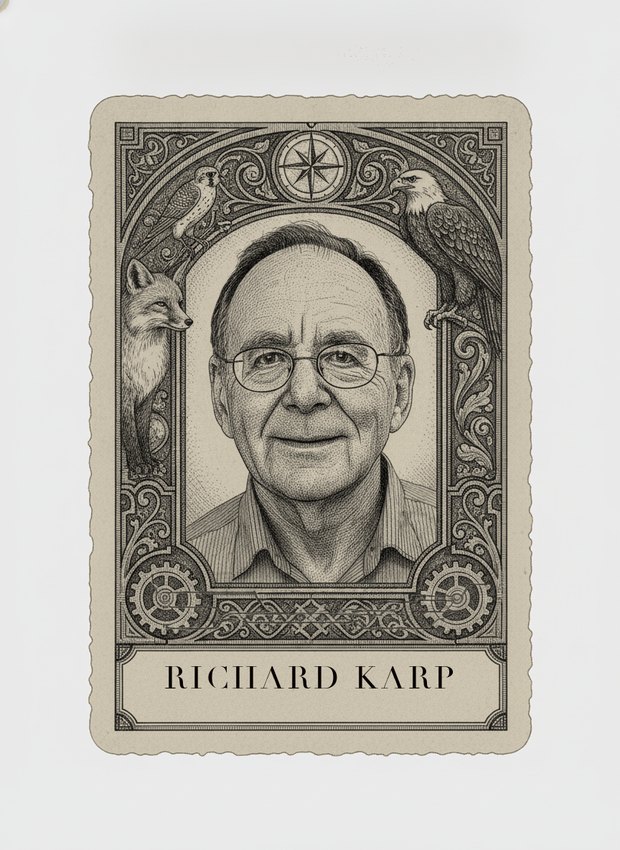
Karp's career is built on exactly this material: his 1972 list of NP-complete problems included matching and covering problems, and his subsequent work on efficient and approximation algorithms for graph matching, including probabilistic analysis of matching heuristics, gives him direct technical purchase on cycle- and chain-constrained kidney exchange. He would recognize immediately that capping cycles at two or three (because simultaneous surgery is required) turns a clean bipartite-matching problem into a harder constrained combinatorial one, and that altruistic-donor chains change the graph's structure in a way that rewards careful algorithm design over brute force. His Berkeley-era work on randomized and approximation algorithms for hard combinatorial problems on graphs is close to the actual computational core of the real 2000s kidney-exchange clearing algorithms.
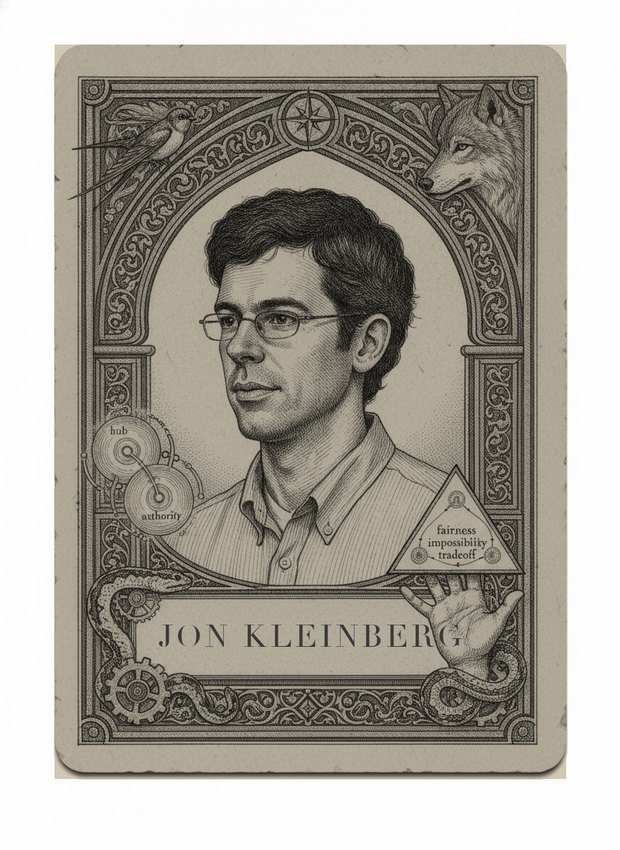
Kleinberg's career-long focus on the algorithmic structure of networks — matching, flows, and the social consequences of how a graph algorithm is designed — puts him close to the center of this problem. Formalizing kidney exchange as directed-graph matching under cycle-length and chain constraints is precisely the kind of algorithms-meet-society question his work on networks and, later, algorithmic fairness addresses directly. He would push hard on the second half of the problem: that 'maximum transplants' and 'priority to the hardest-to-match' are different objective functions that produce different matchings and therefore different survivors, a framing central to his interest in how algorithm design encodes value judgments. His gap is that the specific clearing algorithms for barter exchange markets were built by others in his own generation.
In the mind map
The same ideas, as concepts rather than history — in John's ML knowledge map.
42 figures are scored on this problem. Draw it in a battle to see where you land.