systems
One compiler, three mother tongues
It is 1957 at Remington Rand, and FLOW-MATIC has proven the case in English: a billing clerk who has never seen an opcode writes COMPARE PRICE OF PRODUCT WITH RECORD and gets correct machine code back. Now European offices want the same power in their own tongue, and a skeptical vice president wants proof that "readable" was never a synonym for "English" — that the notation was a choice, not a constraint the machine imposed. One grammar, one parser, one compiled instruction stream sit underneath. Build a keyword table that swaps COMPARE for COMPARER or VERGLEICHEN into the identical statement structure and the identical backend, so a French or German clerk reads and writes fluently while the object code, byte for byte, never changes. Get the separation wrong — let English leak into the grammar instead of staying confined to swappable vocabulary — and "human-readable" quietly reverts to "readable by whoever speaks English," and the compiler's whole argument collapses back into a priesthood, just a differently accented one.
Who this problem belongs to
The two figures whose methods fit it best, out of 8 in contention.
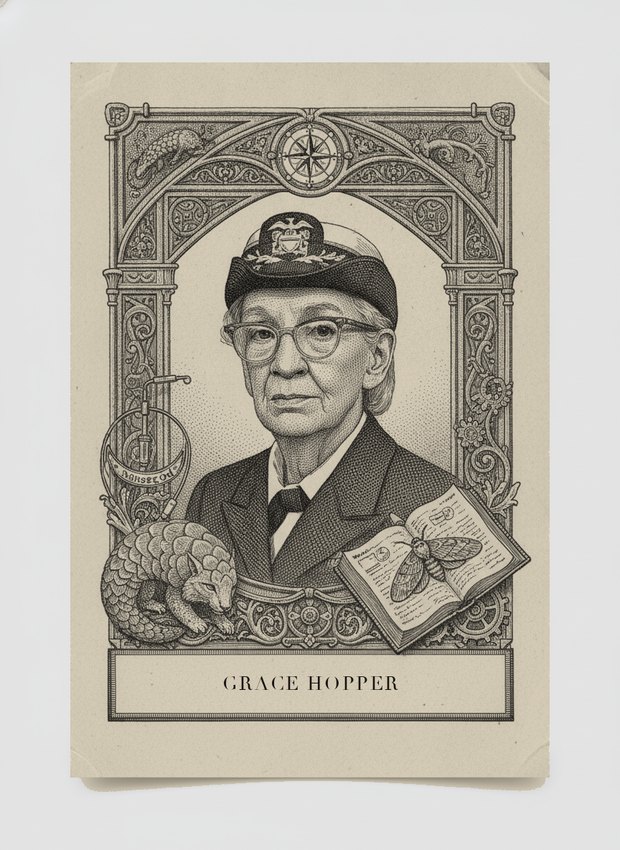
This is documented, not extrapolated. Hopper's group at Remington Rand, working from the A-2 system through FLOW-MATIC (1955-1959), built early demonstrations of the same compiler backend driven by French- and German-keyword front ends, explicitly to prove that keywords are notation, not meaning — a claim she had to defend against colleagues who insisted computers could only do arithmetic and could never be made to understand English. Her entire career rests on the division of labor this problem tests: the programmer specifies intent in a notation designed for the reader, and the compiler, not the vocabulary, is responsible for the correct instruction stream. Swapping COMPARE for COMPARER is a direct extension of a separation she had already built and defended. Docked slightly only because the multilingual front ends were demonstrations alongside FLOW-MATIC's main English push, not a shipped commercial product line in their own right.
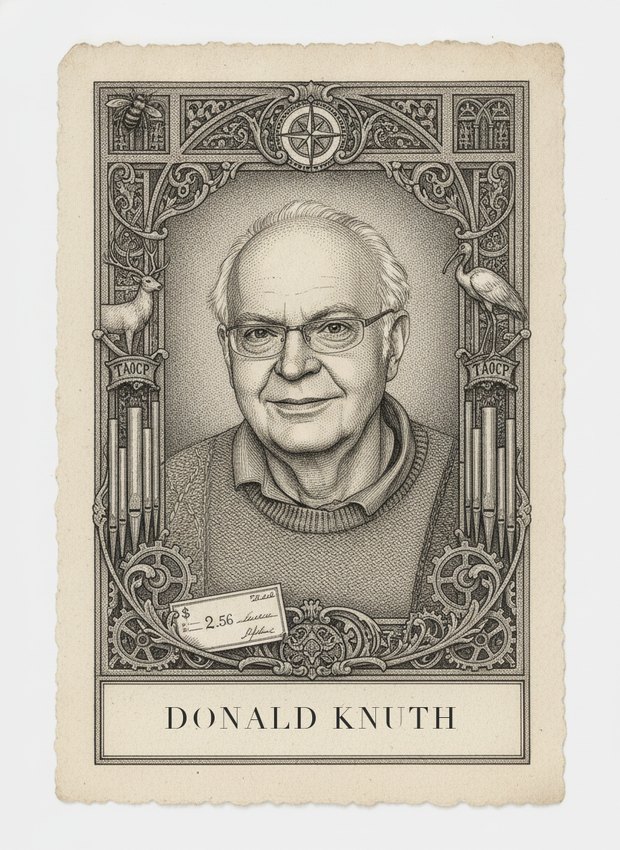
Knuth's literate programming (1984, published as WEB) is the other historically serious answer to "design the notation for the reader, not the machine": source interleaves prose and code so the program reads as an essay a human can follow start to finish, with a separate tangle step extracting what the compiler actually needs. That is a genuine, independently invented instance of Hopper's separation — human-facing text and machine-facing output produced from one source, kept deliberately apart. What keeps him below Hopper is the direction of the split: literate programming optimizes the reader's understanding of one program's logic, not a vocabulary swappable across human languages, and a French WEB document would still be English-only prose grafted onto Pascal. He would recognize this problem's structure instantly and could design the keyword table competently, but the specific multilingual portability is Hopper's invention, not his.
8 figures are scored on this problem. Draw it in a battle to see where you land.