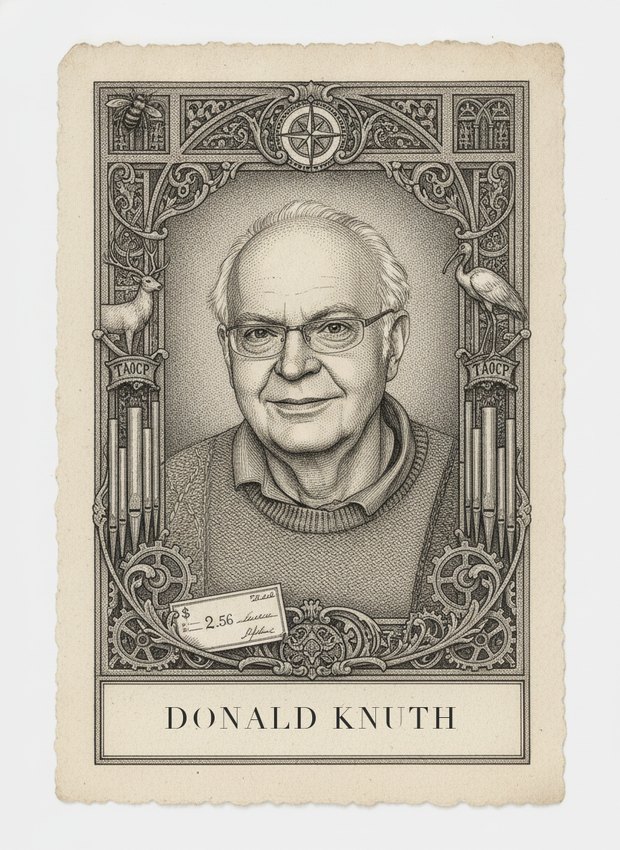
Donald Knuth
The Art of Computer Programming; analysis of algorithms; TeX
Strongest on
In the mind map
The same ideas, as concepts rather than history — in John's ML knowledge map.
Life and career
In 1976, Donald Knuth received the galley proofs for the second edition of the second volume of *The Art of Computer Programming* and found the typography intolerable. The publisher had switched from hot-metal Monotype to photographic typesetting, and the mathematics looked, to him, ugly. Most authors would have complained. Knuth stopped writing the books and spent the next decade building a typesetting system from first principles — TeX for the layout, METAFONT for designing the letterforms themselves, and Computer Modern as the typeface. He estimated the detour would take six months. It took roughly ten years. It is also the reason essentially every paper this audience will ever write is set in TeX.
Knuth was born in Milwaukee in 1938. His father taught bookkeeping and played the organ at a Lutheran church, and both of those inheritances stuck: Knuth is a serious organist with an instrument in his home, and his approach to algorithms has the exactness of double-entry accounting. As a high school student he won a national contest by finding more words constructible from the letters in "Ziegler's Giant Bar" than the judges had — reportedly by taking days off school to work through an unabridged dictionary, which tells you most of what you need to know about his methods.
He went to Case Institute of Technology to study physics, switched to mathematics, and encountered an IBM 650. He wrote a compiler as an undergraduate and did consulting work for Burroughs. Case awarded him a master's degree simultaneously with his bachelor's in 1960, by a special faculty vote. His PhD came from Caltech in 1963 in mathematics, on finite semifields, and he stayed on the Caltech faculty before moving to Stanford in 1968, where he has been ever since, as Professor Emeritus of The Art of Computer Programming.
In 1962, a publisher asked him to write a book about compilers. He produced an outline for twelve chapters and a draft of some 3,000 handwritten pages, at which point it became clear this was not a book but a series. Volume 1 appeared in 1968, Volume 2 in 1969, Volume 3 in 1973. Volume 4, on combinatorial algorithms, has been appearing in fascicles since 2005 — it grew so large that the "volume" is now a shelf. The books established that algorithms could be analyzed *exactly*, with generating functions and asymptotics, rather than described informally.
Knuth's habits are famous and mostly true. He pays a reward of $2.56 — "one hexadecimal dollar" — for each error found in his books, and the checks are so prized that few are cashed. He stopped using email in 1990, on the grounds that his job is to be on the bottom of things rather than on top of them. He wrote a small book, *Surreal Numbers*, presenting John Conway's number system as a novella. He received the Turing Award in 1974 at thirty-six, the National Medal of Science in 1979, and the Kyoto Prize in 1996.
Key contributions
**The analysis of algorithms as a discipline.** Before *TAOCP*, people knew that some programs were faster than others; Knuth made the speed a mathematical object. His method is to count operations exactly — not up to a constant factor but exactly, as a function of input size and often of the input distribution — using generating functions, recurrence solving, and asymptotic expansion. The famous critique of premature optimization ("premature optimization is the root of all evil," which in context is an argument for measuring first and optimizing the 3% that matters) comes from a 1974 paper, and it is the practical counterpart of the theoretical program. Knuth also popularized big-O notation from analysis into computer science, introduced the Ω and Θ conventions in their current algorithmic sense, and invented the MIX and later MMIX hypothetical machines so that operation counts would be well-defined rather than machine-dependent.
**Knuth–Morris–Pratt (1977).** String matching in *O*(*n* + *m*) by precomputing, for each prefix of the pattern, the length of its longest proper border — so that on a mismatch the pattern can be shifted without ever re-examining a text character. It is the canonical example of preprocessing the query to make the scan linear.
**Analysis of alpha-beta pruning (1975, with Ronald Moore).** Alpha-beta was folklore for years, known to work and not understood. Knuth and Moore proved theorems about it: worst-case and best-case bounds on the number of leaves examined, and the result that with optimal move ordering the algorithm visits roughly the square root of the nodes minimax would — meaning a fixed compute budget buys close to twice the search depth. This is a theorem about all game trees, not a benchmark on one program, and it is the reason game-playing programs could be engineered rather than tuned.
**Attribute grammars (1968).** A method for attaching semantics to context-free grammar productions via synthesized attributes (computed bottom-up from children) and inherited attributes (passed down from parents), with the dependency structure determining evaluation order. It gave compiler construction a declarative formalism for semantic analysis and is a genuine contribution to programming language theory. He also did foundational work on LR parsing, formalizing the class of grammars that can be parsed deterministically left-to-right with one-symbol lookahead.
**TeX, METAFONT, and literate programming.** TeX's line-breaking algorithm is a dynamic program that optimizes badness over the whole paragraph rather than greedily line by line — a genuine algorithmic contribution hiding inside a typesetting tool. METAFONT defines glyphs by parametric pen strokes rather than outlines. **Literate programming** inverts the usual relationship between code and documentation: you write an essay explaining the program, with code fragments embedded in the order that makes them comprehensible to a human, and a tool extracts the compilable source. The entire TeX source was published this way as a book, which is close to unique in software.
**Miscellaneous depth.** Knuth co-developed the Knuth–Bendix completion algorithm for term rewriting, contributed to the analysis of hashing and of random number generation (Volume 2 remains a standard reference on both), introduced Dancing Links for exact cover problems, and — with the "Concrete Mathematics" text written with Graham and Patashnik — supplied the mathematical toolkit his own analyses require.
In battle
Knuth's profile is unusually well-rounded for a theorist: mean 41.9, median 40, five dominant scores, ten at 70 or above, and only twenty problems at or below 20. The breadth comes from *TAOCP* itself — a person who has analyzed sorting, searching, hashing, random numbers, arithmetic, and combinatorial generation with equal exactness has something to say about a wide swath of computing.
His peak is **Prune the game tree, provably** (P199) at 99, which is literally his 1975 paper with Moore. The problem asks for a theorem about all game trees rather than a benchmark, and the square-root result with perfect move ordering is exactly that theorem. **The arithmetic that drifts** (P251) at 90 is floating-point error analysis, where Volume 2's treatment of seminumerical algorithms is the classic reference. **Solve the game, completely** (P204) at 86 is exhaustive game solving, the combinatorial-generation territory Volume 4 covers. **The language for the job** (P079) at 84 is programming language design and compilation — attribute grammars, LR parsing, and a compiler written as an undergraduate all bear. **Solve the impossible formula** (P187) at 80 is SAT solving, on which Volume 4's fascicle 6 is a modern standard reference. **Shortest path through the map** (P046) at 78 and **Prove the program correct** (P048) at 78 and **The compiler that beats the coder** (P244) at 74 round out the band.
His category means show the spread: `systems` 69.8, `information` 65.5, `search` 58.6 across fourteen problems, `computability` 51.9 across sixteen, `games` 43.8 across fourteen, `optimization` 37.2, `networks` 36.2.
Where he falls off, he falls off in a very specific way. He scores 11 on **Count the fish you cannot see** (P103, capture-recapture), 10 on **Missing, not at random** (P060), 10 on **The trend with a memory** (P138, time series with state), 10 on **The agent that games its reward** (P225), 8 on **The ruler that lies a little** (P140, measurement error), and 6 on **Name what you've never trained on** (P243, contrastive vision-language pretraining and zero-shot transfer) — his floor. His `regression` mean is 9.0, `rl` 12.5, `classification` 13.5, `experimental-design` 14.0.
The distinction that matters is between *probability* and *statistics*. Knuth is extremely good at probability: the analysis of hashing, of random number generators, of average-case algorithm behavior all require serious probabilistic reasoning, and Volume 2 is one of the most careful treatments of pseudorandomness ever written. His `high-dim` mean of 42.5 and `testing` mean of 29.5 reflect this genuine competence. What he has never done is *inference* — estimating an unknown quantity from noisy observations and quantifying how wrong you might be. Missing data, measurement error, capture-recapture, and every problem in the game that begins with a dataset rather than an algorithm fall outside his method entirely.
The 2021 deep learning problems are a harder floor still, and honestly so: there is nothing in sixty years of exact combinatorial analysis that touches contrastive pretraining on noisy web-scale image-caption pairs. Knuth's virtue is knowing precisely what a procedure does; the modern paradigm's characteristic move is to accept not knowing, in exchange for performance. That is not a gap in his knowledge — it is a disagreement about what counts as understanding, and the game scores the disagreement rather than papering over it.
Play Knuth on any question about an algorithm's exact behavior, on game tree search, on numerical error, on language and compiler design, and on combinatorial generation. Do not play him anywhere the answer is an estimate.