optimization
The fortune that never sits still
It is 1969, and continuous-time finance is being born. An investor holds wealth invested in a risky asset whose price jitters every instant as geometric Brownian motion, and you must choose, continuously, how much to consume now and what fraction of wealth to keep invested, so as to maximize expected lifetime satisfaction from consumption. Ordinary calculus says the value of holding wealth changes only through its average drift — but wealth's random path has unbounded quadratic variation, and dropping the curvature term this forces silently mis-prices the risk in every allocation. Expand the value function along the wealth process correctly, extract the extra second-order term the noise demands, and collapse a problem of choosing an action at every instant into one deterministic partial differential equation you can actually solve. Miss the correction and the 'optimal' policy quietly ignores volatility — a strategy that looks fine on average and wrecks portfolios in the tails.
Who this problem belongs to
The two figures whose methods fit it best, out of 8 in contention.
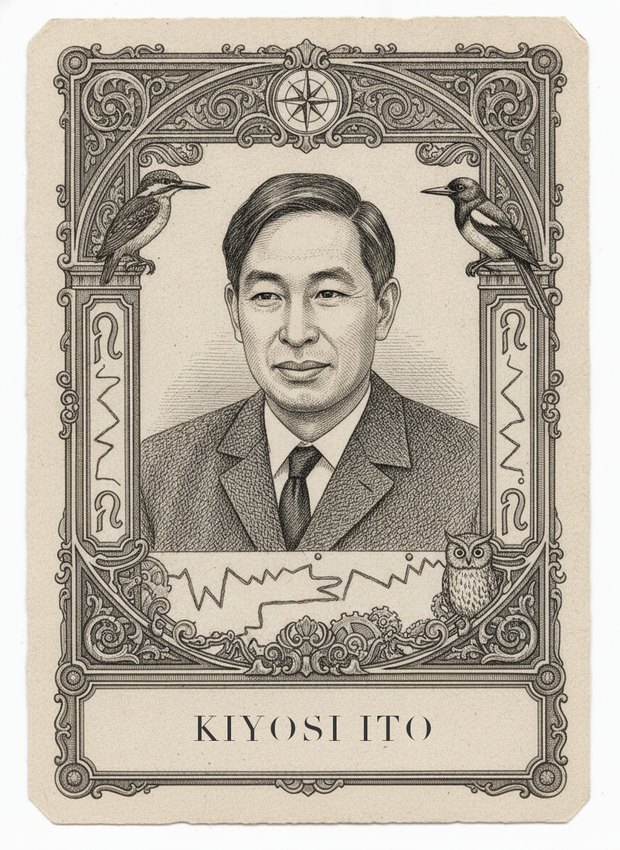
This problem is Ito's own mathematics doing exactly the job he built it for. His 1942 and 1944 papers on stochastic integration and his lemma — the chain rule correction df(X) = f'(X)dX + ½f''(X)σ²dt for a function of a diffusion — are precisely the machinery needed to expand a value function along a randomly evolving wealth process. Wealth driven by geometric Brownian motion accumulates quadratic variation at rate σ²W², and only Ito's second-order term captures the curvature this forces into the value function's evolution; ordinary calculus silently drops it. Applying his lemma converts the stochastic control problem into a deterministic PDE for the value function, exactly the move that later underlies Merton's portfolio theory and the Black-Scholes equation, both descended directly from his 1940s construction. The one point withheld: he built the calculus, not the optimization framework layered on top of it — that synthesis with dynamic programming is others' contribution.
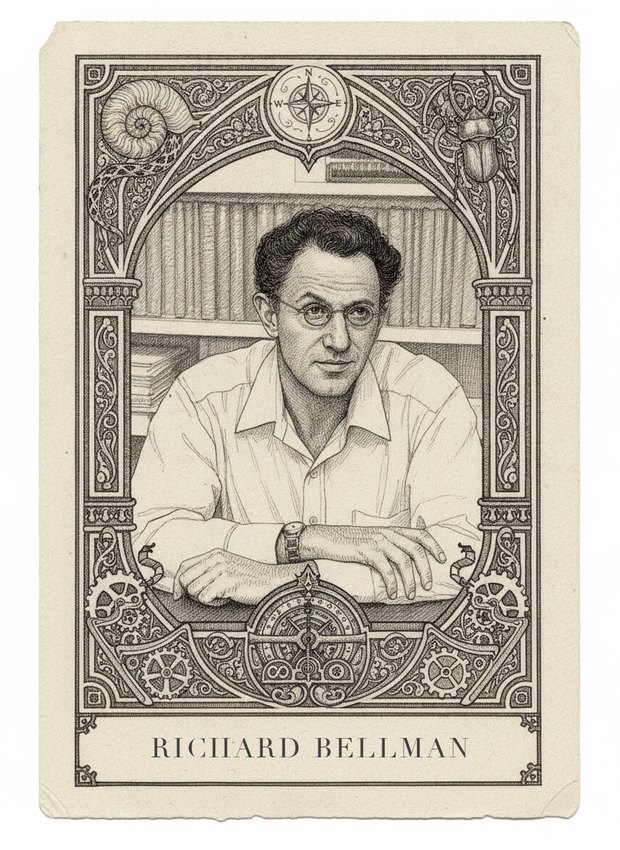
Bellman supplies half of this problem's architecture and none of its critical correction. His 1953 principle of optimality and the equation bearing his name reduce a sequential decision problem to a recursive relationship between the value of a state now and the value of the state that follows — exactly the reasoning that collapses 'choose an action every instant' into one PDE. Applied to continuous time with a diffusion, this became the Hamilton-Jacobi-Bellman equation, and Bellman himself worked at RAND on stochastic and adaptive control problems into the 1960s. What his own corpus does not supply is the specific second-order term the noise forces into the value function's evolution — deriving that term is Ito's lemma applied to the value function, not the dynamic-programming principle itself. He built the recursive skeleton; someone else's calculus explains why the curvature term appears.
8 figures are scored on this problem. Draw it in a battle to see where you land.