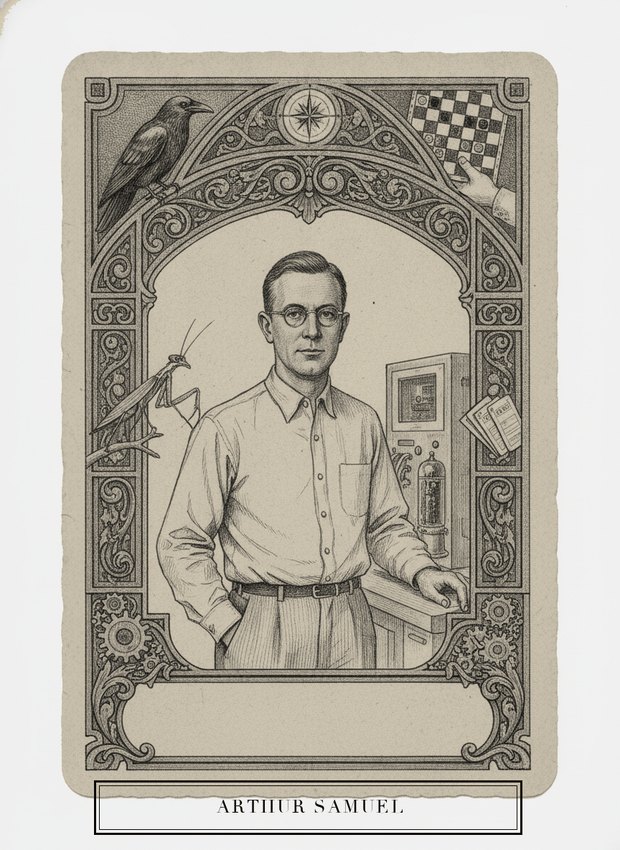
Arthur Samuel
Checkers program that learned; coined 'machine learning'
Strongest on
In the mind map
The same ideas, as concepts rather than history — in John's ML knowledge map.
Life and career
Arthur Lee Samuel spent the first half of his career as a vacuum-tube engineer and the second half proving that a machine could get better at something than the person who programmed it. The two halves are connected: he understood the hardware well enough to know exactly how little of it he had to work with.
Born in Emporia, Kansas, in 1901, Samuel took a bachelor's degree at the College of Emporia and then a master's in electrical engineering at MIT, where he stayed briefly as an instructor before joining Bell Telephone Laboratories in 1928. He spent nearly two decades at Bell Labs on vacuum-tube research — microwave tubes, and during the Second World War work connected to radar. This was serious, physical engineering, and it made him one of the people who knew what electronics could actually do.
In 1946 he moved to the University of Illinois as a professor, where he was involved with the ILLIAC computer project. And in 1949 he joined IBM at the Poughkeepsie laboratory, arriving just as IBM was building its first stored-program electronic computer, the 701. Samuel's assignment was partly to help make the machine work. His side project was checkers.
The choice of checkers was deliberate and, in retrospect, brilliantly judged. Samuel wanted a task that was unambiguously "intelligent" in the public mind, had a compact and unambiguous representation, admitted a clear measure of success, and — critically — could fit in a machine with a few thousand words of memory. Chess was too big; tic-tac-toe was too small. Checkers sat in the window.
He began writing checkers programs around 1949 and kept refining them for the better part of two decades, through the IBM 701, 704, 7090, and beyond. The 1959 paper in the *IBM Journal of Research and Development*, "Some Studies in Machine Learning Using the Game of Checkers," is one of the founding documents of the field and is where the phrase *machine learning* enters the literature. A second paper in 1967 reported substantial further progress. In 1962 the program played an exhibition match against Robert Nealey, a strong Connecticut player, and won a game — an event that IBM publicized enthusiastically and that has been overstated ever since (Nealey was not the world champion, and later matches against genuine masters went badly). What is not overstated is the demonstration itself: a program that played better than its author, having improved by playing itself.
There is a second reason Samuel matters to IBM's history. The checkers demonstration, run on the 701 in 1956 and broadcast on television, moved IBM's stock and did a great deal to establish the idea that computers were more than accounting machines. Samuel was, incidentally, also a significant contributor to early IBM systems software work.
He retired from IBM in 1966 and moved to Stanford, joining the AI laboratory as a research professor, where he worked for the rest of his life — including substantial work on the TeX project with Donald Knuth, writing documentation and helping port the system. He continued programming into his eighties, and kept refining checkers. He died in 1990 of complications from Parkinson's disease.
Key contributions
**The learning checkers program.** Strip away the historical romance and what Samuel built is recognizable as a modern system, assembled from components that mostly did not exist yet.
*Minimax search with alpha-beta pruning.* Samuel's program searched the game tree several ply deep, backing up values by minimax, with a pruning scheme that avoided expanding branches that could not affect the root value. Alpha-beta has multiple independent inventors and Samuel did not publish a formal treatment, but his 1959 paper describes a working version of the idea, and he understood the crucial practical consequence: move ordering determines whether pruning helps a little or enormously.
*A linear evaluation function over hand-crafted features.* The heart of the program is $V(s) = \sum_i w_i f_i(s)$, where the $f_i$ are checkers-specific features — piece advantage, king advantage, center control, mobility, exchange potential, and a few dozen others. Samuel maintained a pool of candidate features and a mechanism for rotating unused ones out of the active set, which is feature selection under a hard budget.
*Learning by generalization — temporal-difference learning, three decades early.* This is the contribution that earns Samuel his place. The problem: you cannot label positions with their true value, because you do not know it. Samuel's answer was to make the evaluation function consistent with itself across time. Take a position, compute its static evaluation, then run a deep lookahead from it and back up a minimax value. If the deep value disagrees with the shallow static value, the static value is wrong — adjust the weights to reduce the gap. In modern notation, he was minimizing something very close to $\left(V(s_t) - V(s_{t+k})\right)^2$ by gradient-like weight updates, bootstrapping a value function from its own later estimates without any external supervision signal until the terminal outcome. Richard Sutton, introducing TD learning formally in 1988, explicitly credited Samuel as its origin. Anyone who has trained a value network by self-play — TD-Gammon, AlphaZero — is running Samuel's loop with better function approximators.
*Rote learning.* The program stored evaluated board positions in a hash table indexed by a compact board encoding, so that a position reached at the frontier of a search might already have a backed-up value from an earlier, deeper search. The effective search depth therefore grew with experience. This is a transposition table plus a learned endgame cache, and Samuel had to invent aggressive storage and replacement policies to make it fit in a machine with vanishingly little memory.
*Self-play and the alpha/beta pair of programs.* Samuel ran two copies, one with the current weights and one with a perturbed or previous set, played them against each other, and kept the winner — a hill-climbing scheme over parameter space driven entirely by self-generated experience. Again: no human labels, no external data.
**Coining "machine learning."** Samuel's definition — that machine learning is the field of study giving computers the ability to learn without being explicitly programmed — is quoted so widely, and attributed to him so loosely, that the exact wording is disputed. What is not disputed is that his 1959 paper made the phrase standard and made the claim behind it concrete.
In battle
Samuel is one of the sharpest specialists on the roster, and the numbers are brutal about it: 100 problems, mean 21.9, median 15, only three problems at 80 or above, and sixty-four at 20 or below. He carries almost nothing outside his lane, and the matrix does not pretend otherwise.
His categories tell the whole story. **rl** at 43.3, **games** at 37.6 across 16 problems, and **search** at 33.7 across 16 are his only areas above 33. Everything else is in the teens or single digits: **regression** 5.0, **testing** 7.0, **computability** 7.5, **causality** 9.6 across 18 problems, **small-sample** 10.5.
The apex is **P053 — Teach the machine checkers** at 98 — literally his life, at the stated institution in the stated decade, and the matrix docks the two points only because the program plateaued short of championship play, a limit Samuel himself acknowledged. **P204 — Solve the game, completely** (90) is the checkers endgame-database and eventual weak-solution lineage that runs directly from his work. **P194 — Prune the adversary's replies** (85) is alpha-beta, which he implemented and understood operationally before it was formalized.
After those three the drop is steep and instructive. **P200 — Beat the world champion** sits at only 56 — Deep Blue's problem is chess at a branching factor and hardware scale that dwarfs checkers, and Samuel's hand-tuned linear evaluation and small transposition cache do not extrapolate to it. **P120 — Play the winner** (55) and **P259 — The imitation game, scored** (55) are adjacent-but-not-his. **P065 — Balance the broomstick** (58) gives him partial credit for the self-improving-controller idea without the control theory. **P046 — Shortest path through the map** (54) rewards general search intuition, not a specific algorithm he invented.
The floor is where the pedagogy is. Samuel bottoms out at 3–5 on **P217 — How high must the dike be?**, **P216 — Calculus for a jagged path**, **P215 — The therapy the trial reversed**, **P214 — The paradox in the admissions data**, **P213 — The posterior at web scale**, and **P212 — Sample from the impossible posterior**. Extreme value theory, stochastic calculus, Simpson's paradox, confounded trials, and scalable Bayesian inference are all *statistics*, and Samuel had essentially no statistical training or output. His learning rule is a deterministic weight-adjustment heuristic on a linear function, tuned by game outcomes; it carries no notion of a sampling distribution, a posterior, a confounder, or a tail. His 9.6 average across eighteen causality problems is the single most telling number in his profile: the man who invented learning from self-generated experience had no framework whatsoever for distinguishing correlation from cause.
Play Samuel on any two-player deterministic perfect-information game, on self-play, on evaluation-function learning, and on memory-constrained search. Play him nowhere else.