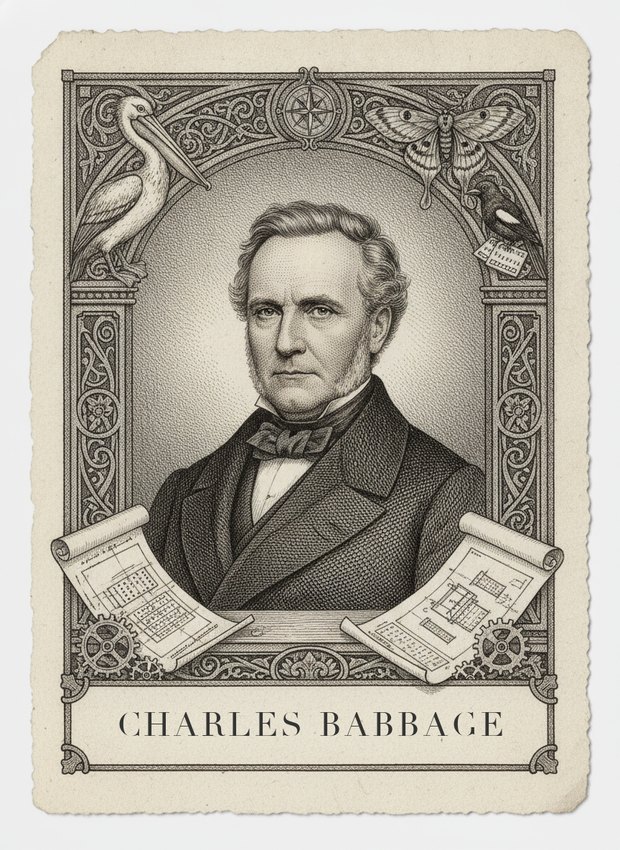
Charles Babbage
Designed the first programmable computer (Analytical Engine)
Strongest on
Life and career
Charles Babbage was born in London in 1791, the son of a banker, which mattered: he had money, and money is what let him spend four decades pursuing a machine no government would fully fund. He went up to Trinity College, Cambridge in 1810 already better read in continental mathematics than his instructors, and promptly co-founded the Analytical Society with John Herschel and George Peacock — a student campaign to replace Newton's clumsy dot notation for the calculus with Leibniz's d-notation. The slogan, that they stood for "the principles of pure D-ism against the Dot-age of the University," is a bad pun that nonetheless describes a real and successful reform of British mathematics.
He was elected to the Royal Society in 1816, helped found the Astronomical Society and later the British Association for the Advancement of Science, and held the Lucasian Chair of Mathematics at Cambridge from 1828 to 1839 — Newton's chair, later Dirac's and Hawking's — without, by all accounts, lecturing. He was a pamphleteer and controversialist of considerable energy: his *Reflections on the Decline of Science in England* (1830) attacked the Royal Society establishment for cronyism, and his *On the Economy of Machinery and Manufactures* (1832) was a serious and influential work of what we would now call operations research and industrial economics, containing an analysis of how dividing labor lets a manufacturer buy exactly the grade of skill each subtask requires — a principle later applied, pointedly, to the division of *computational* labor.
The machines are the through-line. The Difference Engine, conceived in the early 1820s, was designed to compute and typeset polynomial approximations by the method of finite differences, eliminating both the arithmetic errors and the typesetting errors that made contemporary navigational and logarithmic tables dangerous. The British government funded it heavily and Babbage's relationship with his engineer, Joseph Clement, broke down over costs and ownership of the tooling; the project was abandoned unfinished, though a substantial demonstration piece was assembled.
Then, around 1834, Babbage conceived something far more radical: the Analytical Engine. It was to have a *store* for numbers and a *mill* for arithmetic — memory and processor — with instructions and data fed in on punched cards borrowed from the Jacquard loom, and, crucially, a mechanism for conditional branching so the machine could alter its own course based on computed results. This is a general-purpose programmable computer, designed in brass and steam, a century before electronics. He never built it. He designed and redesigned it for the rest of his life, produced thousands of pages of drawings and a formal notation for describing mechanism, and died in 1871 with the machine unrealized.
He was also, memorably, an eccentric: he campaigned publicly and furiously against London's street musicians, he broke the Vigenère cipher and kept it quiet, and he proposed instruments and schemes across half a dozen fields. A working Difference Engine No. 2 was eventually constructed from his drawings by the Science Museum in London in the late twentieth century, and it worked, which settled the long-standing question of whether the designs were sound.
Key contributions
Babbage's contribution is architectural, and it is best understood as a set of ideas that were correct and had no descendants — the modern computer was built independently, and Babbage was rediscovered afterward as a prophet rather than an ancestor.
**Separation of store and mill.** The Analytical Engine's division between a memory holding numbers and an arithmetic unit operating on them is the fundamental organizing principle of computer architecture. Babbage arrived at it not from theory but from mechanism: a general machine cannot dedicate hardware to each quantity, so it must move quantities to a single place where operations happen. That the same insight would be rediscovered and formalized in the 1940s does not diminish the fact that he had it in 1837.
**Instructions as data on a removable medium.** Punched cards carried both the numbers and the operations. This makes the machine's behavior a *thing you can write*, distinct from the machine itself, which is the conceptual birth of programming as an activity separable from engineering. Ada Lovelace's 1843 notes on the Engine are the working-out of what that implies.
**Conditional branching and iteration.** This is the piece that makes the design general-purpose rather than a fancy calculator. A mechanism that lets the machine test a computed quantity and take a different path accordingly is what separates a program from a fixed sequence, and it is what makes the Analytical Engine, in principle, Turing-complete — a description that could only be applied retrospectively, since Babbage had no theory of computability and no notion that there was anything to be proved about the limits of what machines can decide.
**Mechanized reliability as the point.** Babbage's motivation was not speed but *trust*. Printed mathematical tables of the era were riddled with errors from both human calculation and human typesetting, and ships ran aground because of it. His machines were designed to print their own output, closing the last human-error channel. This framing — that automation's chief virtue is eliminating a class of error rather than doing arithmetic faster — is a genuinely modern engineering instinct.
**Cryptanalysis and industrial analysis.** In the 1850s he broke the Vigenère polyalphabetic cipher, then considered unbreakable, by exploiting statistical repetition in the ciphertext. He did not publish; Friedrich Kasiski independently published an equivalent method and the technique bears Kasiski's name. And *On the Economy of Machinery* is a real contribution to the analysis of production, cost, and the organization of work.
What he lacked is as instructive as what he had: no theory of algorithms, no complexity notion, no proof technique, no working machine, and — fatally for the project — no manufacturing base capable of the precision his designs assumed at the cost he could raise.
In battle
Babbage's numbers are the harshest on the roster of foundational figures, and the game is not being unfair to him. Across a hundred problems his mean is 10.6, his median 8, his ceiling 42. He has *zero* problems at 70 or above and ninety-two at 20 or below. He is, in this game, an argument about what a design is worth when it never runs.
His best showing is "The message no eavesdropper can read" at 42, and it is a genuine if partial claim: his Vigenère break was real cryptanalysis exploiting statistical redundancy, the same leakage Shannon later formalized. But the problem asks for provable security and hardness-based protocol design, and Babbage has ad hoc statistics rather than an impossibility theorem, so he is capped well below the specialists. The rest of his top band shows the same structure — a plausible ancestral claim, heavily discounted. "Schedule the moonshot" (38) and "Feed the army for pennies" (37) reach his industrial-organization and mechanical-calculation work but not the specific optimization mathematics required. "Will it ever halt?" (35), "Prove the program correct" (30), "Let the machine find the proof" (22), and "Program chess before the computer exists" (22) are all problems where the *subject matter* is machines and programs — his home ground — but the *method* required is symbolic logic, diagonalization, or formal semantics, none of which he possessed. His single best category is computability at 25.0, which tells you that even where he belongs, he is scoring in the bottom quartile.
His losses are near-total and they cluster on continuous mathematics. "The corner that sparsity loves" (2) is his floor: convex relaxation and sparsity-inducing regularization, a framework with no nineteenth-century antecedent whatsoever. "Optimize across the datacenter" (2), "Cool it slowly" (3), "Fill in the hidden variables" (3), "Five hundred stocks, one year of days" (3), and "The interpolator that should have failed" (3) span distributed optimization, simulated annealing, EM, high-dimensional covariance estimation, and the benign-overfitting puzzle. Every one requires probabilistic or analytic machinery he never touched. His statistical categories bottom out accordingly — regression 6.0, classification 6.0, causality 8.3, high-dimensional 8.0.
The cruelest number on the sheet is his systems average: 7.4 across eighteen problems, the largest category he carries and one of his weakest. The man who designed the first computer scores in single digits on computer systems. The reason is exact and worth sitting with: modern systems problems are about *operating* infrastructure — concurrency, fault tolerance, consistency, scale, deployment, coordination between machines that already exist. Babbage's expertise is in conceiving an architecture, and he never got past that stage even once. His battle identity is precisely that gap. He wins the argument about what a machine could be and loses every argument about what to do with one.
Play Babbage almost nowhere, and understand that this is the lesson. He is on the roster as the field's most important unrealized idea, and the scores are an honest measure of how much of the distance from vision to working method he actually covered.