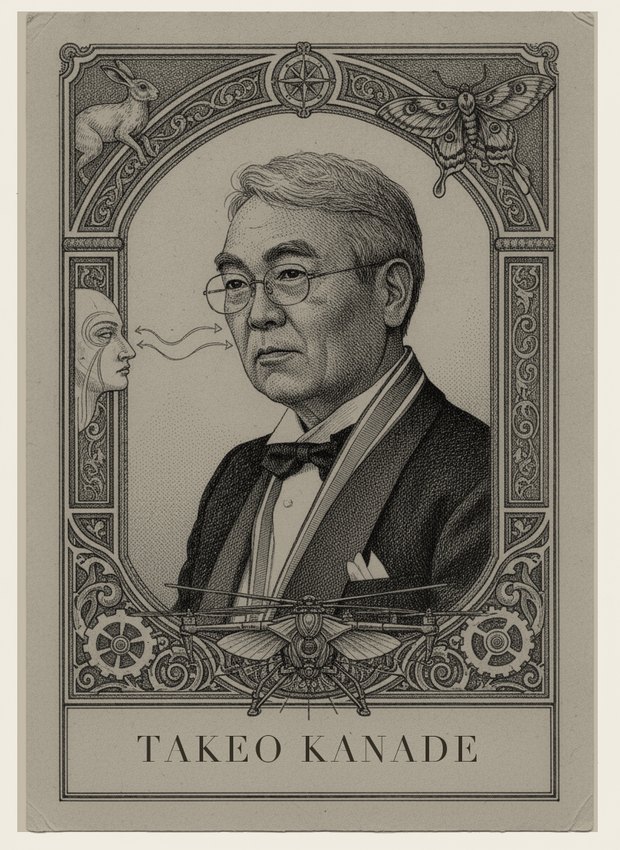
Takeo Kanade
Computer vision: face detection, optical flow, virtualized reality
Played by Andy
Strongest on
Battles
In the mind map
The same ideas, as concepts rather than history — in John's ML knowledge map.
Life and career
Ask a computer-vision researcher to name the field's most consistently productive career and Takeo Kanade's name comes up fast, usually with a story attached about how cheerful he is about it. Born in Japan in 1945, he did his entire education at Kyoto University, taking his doctorate there in the mid-1970s with a thesis on the computer analysis of face images — an attempt to locate facial features automatically and use their geometry for identification. It is routinely described as the first serious work on face recognition by machine, and it was done on hardware that could barely hold a picture in memory. Reading it now, what stands out is the willingness to attack a problem that was obviously twenty years too early, and to attack it with explicit geometric structure because nothing else was available.
He came to Carnegie Mellon around 1980 and never left. He directed the Robotics Institute through the 1990s, held a named professorship in computer science and robotics, and helped found the university's work on technology for aging and disability. Over four decades his lab produced an extraordinary density of methods that became standard: optical flow, feature tracking, structure from motion by factorization, real-time stereo, neural-network face detection, and multi-camera "virtualized reality." He is also responsible for one of the field's most-repeated pieces of advice — *think like an amateur, do as an expert* — meaning that the problem should be chosen with a naive person's directness and unencumbered ambition, and then executed with complete technical rigor. It is a slogan, but it genuinely describes his output: the questions are often embarrassingly simple to state ("where did every pixel go?", "find every face"), and the answers are meticulous.
Two of his projects escaped the lab into public view. The first was the CMU video-rate stereo machine and the vision work that fed autonomous navigation on the ground and in the air — his group flew vision-guided autonomous helicopters in the 1990s, and the stereo lineage connects to depth perception for planetary rovers. The second was EyeVision, the ring of computer-controlled cameras around a stadium that produced the frozen-moment, orbit-around-the-play replay first shown at a Super Bowl in 2001. That was the visible tip of his virtualized-reality program: surround an event with dozens of calibrated cameras, recover the scene's three-dimensional structure, and then synthesize any viewpoint you like, including ones no camera occupied. He has received a long list of international honors for the body of work, including the Kyoto Prize.
Key contributions
**Lucas–Kanade optical flow.** With Bruce Lucas in 1981, Kanade formulated image motion estimation as a small local least-squares problem. The brightness-constancy assumption gives one linear equation per pixel in two unknowns — underdetermined, the aperture problem, which is why you cannot tell how a featureless edge is sliding. Lucas and Kanade broke the degeneracy by assuming flow is constant over a small window, stacking the per-pixel constraints, and solving the resulting 2×2 normal equations built from spatial and temporal image gradients. Two consequences follow that made the method last. First, it is differential and iterative, so with a coarse-to-fine pyramid it handles large motions. Second, the 2×2 structure matrix is itself a *diagnostic*: its eigenvalues tell you whether the window has texture in two independent directions and therefore whether the estimate can be trusted. That observation, developed further in the "good features to track" criterion from his lab with Jianbo Shi and Carlo Tomasi, is why the KLT tracker selects the points it tracks. Forty years on, the algorithm is still in OpenCV and still in production systems.
**Factorization for structure from motion.** With Tomasi in the early 1990s, Kanade showed that under orthographic projection, the matrix of tracked feature positions across frames has rank at most three (up to a translation removal), because it factors into a motion matrix and a shape matrix. That means you can recover camera motion and 3D structure for an entire sequence at once with a singular value decomposition, followed by a metric-upgrade step to resolve the affine ambiguity. This was a striking result: no incremental pose estimation, no nonlinear optimization, no initialization problem — a global, closed-form solution from linear algebra. The subspace insight generalized into the whole literature on motion segmentation, where trajectories of independently moving objects occupy distinct low-dimensional subspaces, and into modern low-rank approaches to structure recovery.
**Face detection that worked.** With Henry Rowley and Shumeet Baluja, and later with Henry Schneiderman, Kanade's lab produced the systems that made face detection a solved-enough problem in the late 1990s: neural-network classifiers scanned over image windows at multiple scales with careful bootstrapped hard-negative mining, and statistical appearance models handling pose variation. This is the direct methodological ancestor of the Viola–Jones detector and of everything that put a green box around your face in a camera viewfinder.
**Real-time stereo and virtualized reality.** The video-rate stereo machine used multiple baselines to reduce depth ambiguity and produced dense depth maps fast enough for a moving robot, a hardware-and-algorithm co-design problem as much as a vision one. Virtualized reality extended the same reconstruction ideas to many cameras and dynamic scenes, producing free-viewpoint video — an idea that reappears today in multi-view neural reconstruction with different machinery and the same goal.
**Robotics beyond vision.** Kanade also worked on manipulation, contributing to the CMU direct-drive arm — removing gears from the joint so the actuator drives the link directly, which trades away torque density for backdrivability and control bandwidth — and to medical robotics and image-guided surgical navigation.
In battle
Kanade's profile is the classic deep specialist's: mean 21.8, median 14, six dominant problems, and seventy problems at or below 20. Perception at 47.1 across nineteen problems is his only broad strength, and everything else on his category sheet sits under 35.
Where he wins, he wins as the author. "Where did every pixel go?" (98) is Lucas–Kanade; the problem statement is his 1981 paper's setup, aperture problem included. "The subspaces of moving objects" (90) is Tomasi–Kanade factorization and its motion-segmentation descendants. "Find every face" (95) is his lab's detection work, sitting on top of a thesis he wrote twenty-five years earlier on the same subject. "Depth for a robot on Mars" (97) is real-time stereo for a vehicle that cannot phone home for help — his multi-baseline hardware work almost exactly. "Rebuild the city from vacation photos" (88) is large-scale structure from motion, where the modern bundle-adjustment pipelines are not literally his but descend directly from the factorization line. "Edges before objects" (74) puts him in Marr's territory, competent but not the owner. "The robot learns to grasp" (71) rewards the manipulation side of the Robotics Institute.
"Arrested by a false match" (85) is the most interesting entry on his sheet. It is a fairness and harm problem — face recognition producing a wrongful identification — and Kanade scores high not because he worked on algorithmic fairness but because he understands, better than almost anyone alive, what a face-matching system's error modes actually are and where its confidence comes from. Note that his overall fairness average is only 21.7; he wins this one specifically because it is *his* technology failing.
The losses are uniform and they are all statistical. "Calculus for a jagged path" (3) is Itô calculus, "Sample from the impossible posterior" (3) is MCMC, "The posterior at web scale" (4) is variational inference, "Who wrote the disputed papers?" (4) is Bayesian authorship attribution, "The coefficient that flips sign" (4) is regression diagnostics, and "Climb the yield surface" (4) is response-surface experimental design. His causality average is 9.2, small-sample 8.0, computability 8.5, NLP 7.6. Kanade's mathematics is linear algebra, calculus of images, and least squares under geometric constraints; probabilistic inference in the Bayesian sense is simply not his instrument, and neither is anything symbolic, linguistic, or combinatorial.
There is one more weakness worth naming plainly, because it is the field's own history. Every one of Kanade's great methods rests on hand-specified geometric or photometric structure — brightness constancy, orthographic projection, rank constraints, explicit feature windows. Deep learning replaced most of that structure with learned features, and on the problems where the winning answer is "train a large network on a large dataset," Kanade's engineered insight is elegant but no longer decisive. The battle profile reflects it: he owns the geometry, and he is beaten wherever the geometry was the thing that got dissolved.