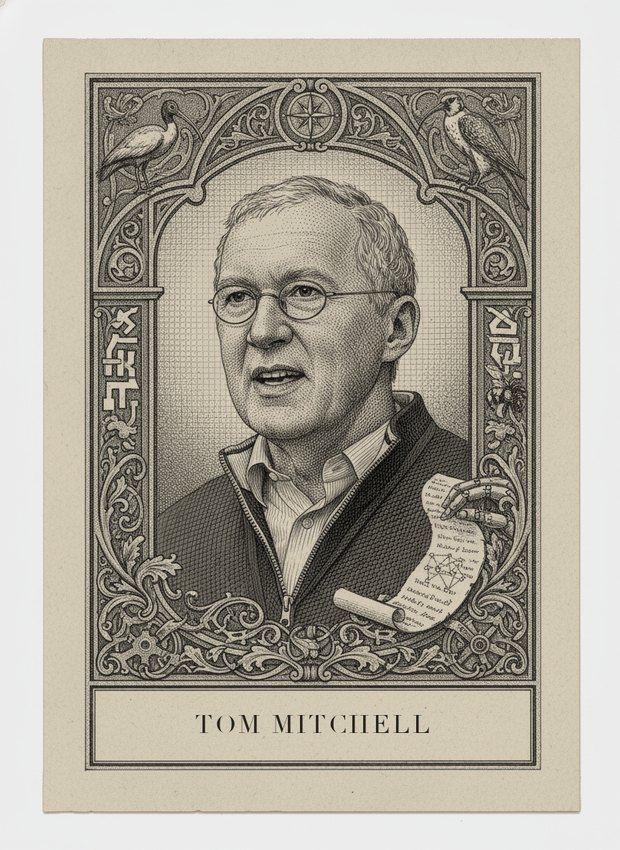
Tom Mitchell
The Machine Learning textbook; 'learning from experience E at task T'; NELL
Played by Nan
Strongest on
Battles
In the mind map
The same ideas, as concepts rather than history — in John's ML knowledge map.
Life and career
More people have learned what machine learning *is* from Tom Mitchell than from anyone else alive. His 1997 textbook opens with a definition that has been recited in lecture halls ever since: a computer program learns from experience E with respect to some class of tasks T and performance measure P if its performance at tasks in T, as measured by P, improves with experience E. It sounds almost tautological until you try to write down T, P and E for a system you actually care about, at which point it does exactly what a good definition should do — it forces you to say what you are claiming.
Mitchell was educated at MIT and took his doctorate at Stanford in the late 1970s, in the era when AI meant symbolic reasoning and machine learning was a small, philosophically anxious subfield trying to work out what it would even mean for a program to generalize. His thesis introduced version spaces, and it is a testament to how good a formalism can be that a piece of noise-free symbolic logic from 1978 is still the clearest way to explain what active learning is doing. He taught at Rutgers before moving to Carnegie Mellon in the mid-1980s, where he has been ever since, and where he did something no one else had: in 2006 he founded and chaired the world's first academic department of machine learning. That is an underrated contribution. Declaring machine learning a department rather than a research group inside computer science was an institutional bet about the field's future that turned out to be conservatively timed.
His research trajectory is unusual in that he did not stay put methodologically. He came up in symbolic concept learning, moved through statistical and semi-supervised learning in the 1990s, spent time in industry as chief scientist at a text-extraction startup during the first web boom, built a decade-long never-ending learning system in the 2010s, and — in the strand that surprises people — spent years doing cognitive neuroscience, using functional brain imaging to study how word meanings are represented in the human brain. He served in senior leadership at CMU's School of Computer Science and has been an active voice in public policy discussions about AI's effects on labor and on privacy. He is a member of the National Academy of Engineering and a fellow of the field's major societies.
Key contributions
**Version spaces and the candidate-elimination algorithm.** Given a hypothesis space partially ordered by generality and a set of labeled examples, the version space is the set of hypotheses consistent with all examples seen so far. Mitchell showed it can be represented compactly by two boundaries — the most specific consistent hypotheses and the most general ones — and maintained incrementally as examples arrive, with candidate elimination tightening the boundaries. This reframed induction as *search through a hypothesis space*, which is the conceptual move the whole field is built on. It also gives an immediate, sharp theory of what makes an example informative: the best query is the one that eliminates the most hypotheses, ideally halving the version space. Modern active learning — query-by-committee, uncertainty sampling, the version-space-volume arguments in Tong and Koller's work — is that idea made probabilistic.
**Inductive bias.** Mitchell's argument that a learner with no bias cannot generalize is one of the foundational statements of the field. If your hypothesis space contains every possible labeling function and you commit to nothing a priori, then consistency with the training data tells you nothing about unseen points; every extension is equally admissible. Generalization is therefore not a property of the data but of the assumptions you brought, and the practical question is never *whether* to have a bias but *which* one and how to state it. Everything from regularization to architecture choice to the implicit-bias literature is a footnote to this.
**Explanation-based learning.** In the 1980s, with students and collaborators, Mitchell developed learning methods that use a domain theory to explain *why* a single training example is an instance of the target concept, then generalize the explanation rather than the surface features. Given a strong prior theory, one example can suffice — a deductive complement to inductive learning. The framework fell out of fashion when noisy, theory-free statistical learning proved more scalable, but it is worth knowing as the most serious attempt to formalize learning from very few examples using structured knowledge.
**Co-training.** The 1998 paper with Avrim Blum is Mitchell's most cited technical contribution and one of the founding results of semi-supervised learning. Suppose each example has two conditionally independent views, each sufficient on its own to classify — a web page's own text and the text of links pointing at it, say. Train a classifier on each view from a small labeled set; each then labels the unlabeled examples it is most confident about, and hands those to the other as training data. The independence between views means one classifier's confident predictions are genuinely informative to the other rather than merely self-confirming, and Blum and Mitchell gave a PAC-style analysis of when this provably reduces the labeled-data requirement. Co-training is the reason "we have thirty labels and thirty thousand unlabeled documents" stopped being hopeless.
**NELL.** The Never-Ending Language Learner, launched around 2010, ran continuously for years, reading the web and populating a growing knowledge base of entities, categories and relations, using coupled semi-supervised learning: many extraction methods constrained by an ontology so that their mutual consistency provides the supervision signal none of them has individually. It accumulated millions of beliefs with confidence scores, learned to improve its own extractors, and — importantly — its errors are as instructive as its successes, since concept drift and semantic slippage over years of self-training are exactly the failure modes any long-running autonomous learner has to solve.
**Brains and word meaning.** With collaborators, Mitchell used fMRI to predict the neural activation pattern associated with a concrete noun from corpus-derived features of that word, showing the mapping generalized to nouns never scanned. It is a striking result about distributed semantic representation in the brain, and a rare case of a machine-learning method used as a scientific instrument rather than an engineering artifact.
In battle
Mitchell's sheet is that of a broad, moderate generalist rather than a spike: mean 28.6, median 22, only two problems above 80 but a solid classification average of 46.7 across seventeen problems and respectable showings across RL, causality, search and games. He is rarely a disaster in the ML core, and rarely dominant.
His two 90s tell you where his real ownership lies. "Which examples deserve labels?" is active learning, and it is his idea industrialized — version spaces gave the field the notion that a label's value is measured in hypotheses eliminated, and NELL later ran choose-your-own-supervision at web scale. The honest caveat the game itself records is worth repeating: his original framework was logical and noise-free, and the probabilistic label-complexity theorems came from others, which is why he does not sit at 99. "The inbox under siege" (90) and "The spam in the inbox" (74) are text classification under adversarial drift, where his combination of semi-supervised learning, feature engineering and long-running system maintenance is directly on point. "Classify with 30 labels and 30,000 unlabeled" (73) is co-training's own problem statement. "Concepts from three examples" (63) is the explanation-based and version-space territory, where he places well but loses to the Bayesian concept-learning tradition. "The resume screener learned the past" (68) and "What is in the training data?" (61) reward the fact that he has spent decades thinking about where supervision actually comes from and what it encodes — his fairness average of 55.0 is his highest category. "The model is five percent of the system" (60) is a systems-engineering problem about deployed ML, and he has run one of the field's longest-lived deployed learners.
The losses are unusually clean, and they all point the same direction: Mitchell has essentially no *mathematical machinery* of his own. "The scratch on the disc" (6) is Reed–Solomon coding over finite fields. "How few bits for a good-enough picture" (8) is rate-distortion theory — his information category average is 7.0, the worst on his sheet. "Optimize for the worst case" (8) is robust optimization, "Even approximating is hard" (9) is hardness of approximation, "Predict the ore grade underground" (9) is kriging and spatial statistics, and "The coefficient that flips sign" (7) is classical regression diagnostics. His optimization average is 17.3 across ten problems and his regression average 20.8 across twelve. He formalized what learning *is*; he did not develop the analysis, coding theory, or convex optimization that other carriers use to actually solve things.
The battle-relevant summary: Mitchell wins when the problem is about *the structure of the learning setting* — which examples to label, how to exploit unlabeled data, what the supervision signal really is, what bias the learner is bringing. He loses benchmark sprints to whoever owns the specific architecture, and he loses any problem whose answer is a theorem.