perception
The picture that isn't there
It is 2014 in Montreal, and generative models of images are stuck in a swamp of intractable likelihoods: the models that can be trained produce mush, and the models that could produce images cannot be trained. The proposal, sketched in a bar argument, is to stop computing likelihoods altogether — train two networks against each other, a forger and a detective, and let the contest itself define the objective. Generate photorealistic images of scenes that never existed, from a learned model of natural images, and make the adversarial training actually converge, which the game theory says is delicate and practice says is worse. The stakes cut both ways: a working method opens generative modeling's modern era — and simultaneously hands the world an engine for images indistinguishable from evidence.
Who this problem belongs to
The two figures whose methods fit it best, out of 53 in contention.
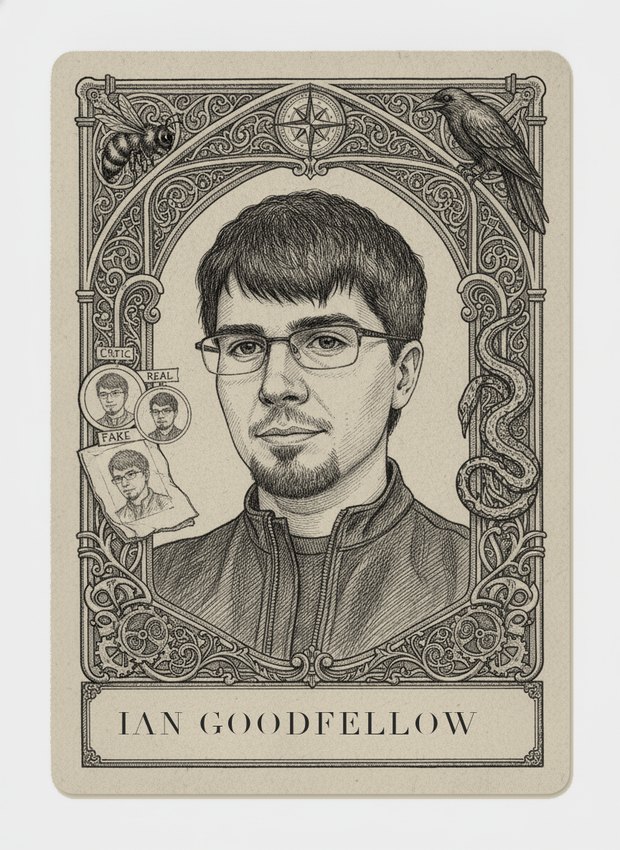
This is Goodfellow's own night at a Montreal bar in 2014, the actual origin story of the adversarial framework: two networks, a generator and a discriminator, trained against each other so the objective emerges from the contest rather than an intractable likelihood computation. He wrote the original paper, proved the theoretical minimax equilibrium, and spent the following years personally wrestling with exactly the convergence instability the problem calls delicate in theory and worse in practice (mode collapse, vanishing gradients for the generator). No other carrier owns both the invention and the empirical fight to make it work; this is the closest to a perfect match the roster offers. Even granting the era gap, Goodfellow's standing on generative adversarial networks is close enough to this problem's actual demands that a graduate student would expect a real, defensible showing rather than a token one.
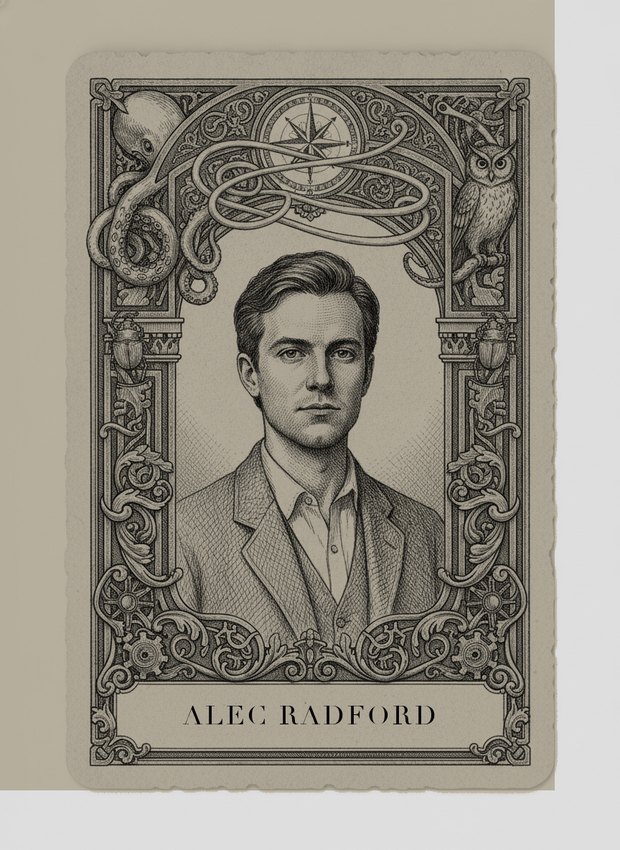
Radford's DCGAN (2015) is the specific, field-changing answer to 'make the adversarial training actually converge': a set of architectural constraints (strided convolutions, batch normalization, careful activation choices) that turned Goodfellow's theoretically elegant but practically finicky framework into something that reliably produced coherent images. This is squarely inside Radford's actual published contribution and squarely what the problem's third beat demands. He arrives a year after the Montreal bar conversation, so credit is for stabilizing the invention rather than originating it, still an extremely direct and empirically grounded fit. Even granting the era gap, Radford's standing on gpt and clip: the language-model lineage is close enough to this problem's actual demands that a graduate student would expect a real, defensible showing rather than a token one.
In the mind map
The same ideas, as concepts rather than history — in John's ML knowledge map.
53 figures are scored on this problem. Draw it in a battle to see where you land.