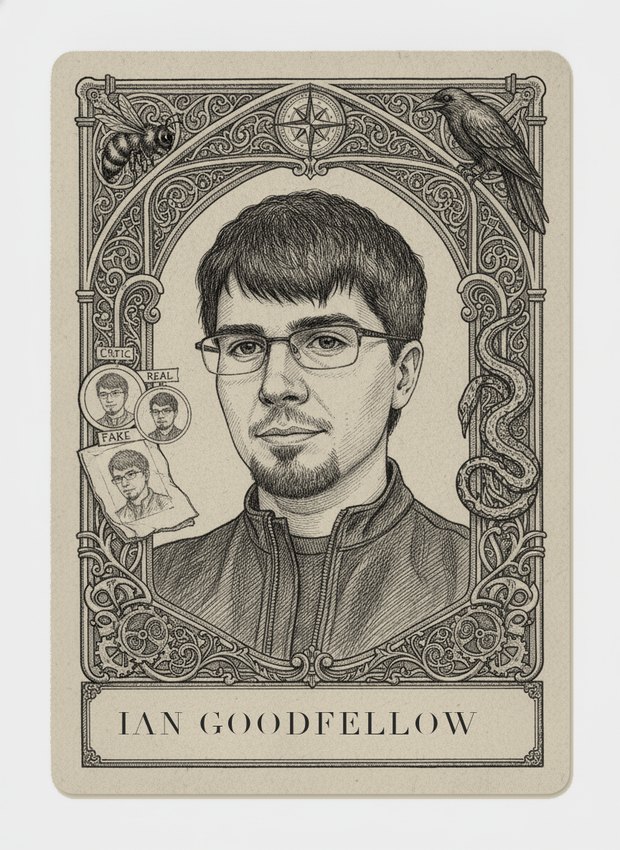
Ian Goodfellow
Generative adversarial networks
Played by Marisa
Strongest on
Battles
In the mind map
The same ideas, as concepts rather than history — in John's ML knowledge map.
Life and career
The story is told so often that it has worn smooth: a Montreal pub in 2014, a friend's going-away party, an argument about how to make a neural network generate realistic images. The prevailing approaches required estimating an intractable partition function or laboriously approximating a likelihood. Ian Goodfellow's counter-proposal, made at the table and reportedly coded up that same night, was to stop trying to write down the objective at all — pit two networks against each other and let the objective be the contest. His colleagues did not think it would work. The first version worked.
The anecdote is a good story but a slightly misleading one, because Goodfellow was not a novice who got lucky. He did his undergraduate and master's work at Stanford, where he worked with Andrew Ng and was among the first cohort of students exposed to GPU-based deep learning as a serious method rather than a curiosity. He then went to Montreal for a PhD under Yoshua Bengio and Aaron Courville at what was then the LISA lab — the other pole, with Toronto, of the deep learning revival. Montreal in 2011–2014 was an intensely productive and slightly monastic environment: a small group of people who had been arguing for neural networks through years of professional disdain, and who by then could feel the field turning.
His pre-GAN work there is substantial and often forgotten. He introduced maxout networks, an activation designed specifically to work well with dropout by letting the unit learn a piecewise-linear convex activation function. He was a major contributor to Theano and to Pylearn2, the software substrate a generation of deep learning research ran on before TensorFlow and PyTorch existed. And during an internship at Google he was first author on a system that read multi-digit street numbers directly from Street View imagery end to end, which was a genuinely hard applied vision result at the time and one Google actually deployed.
After the PhD he went to Google Brain, spent a period at OpenAI shortly after its founding, then returned to Google, where he led a group working on adversarial robustness and machine learning security. Along the way he co-wrote, with Bengio and Courville, the *Deep Learning* textbook (MIT Press, 2016) — for years the only comprehensive graduate reference on the subject and still the standard citation for the field's mathematical foundations.
In 2019 he moved to Apple as a director of machine learning in its Special Projects Group. He left in 2022; his departure was publicly reported to be over the company's return-to-office policy, a detail that circulated widely because it was an unusually blunt public disagreement about remote work from a very senior researcher. He then joined DeepMind as a research scientist.
Key contributions
**Generative adversarial networks (2014).** The paper, with Jean Pouget-Abadie, Mehdi Mirza, Bing Xu, David Warde-Farley, Sherjil Ozair, Courville, and Bengio, sets up a two-player minimax game. A generator $G$ maps noise $z \sim p_z$ to samples; a discriminator $D$ estimates the probability that a sample came from the data rather than from $G$. They optimize
$$\min_G \max_D \; \mathbb{E}_{x\sim p_{\text{data}}}[\log D(x)] + \mathbb{E}_{z\sim p_z}[\log(1 - D(G(z)))].$$
The theoretical content is what makes it more than a trick. For a fixed $G$, the optimal discriminator is $D^*(x) = p_{\text{data}}(x)/(p_{\text{data}}(x) + p_g(x))$, and substituting it back shows the generator is minimizing the Jensen–Shannon divergence between $p_g$ and $p_{\text{data}}$, with a unique global optimum at $p_g = p_{\text{data}}$. So an implicit generative model — one you can sample from but whose density you can never evaluate — is being fit to a proper divergence, with no partition function, no Markov chain, and no variational bound.
The practical content is a decade of pain. The equilibrium is a saddle point of a non-convex game, and gradient descent on both players does not reliably find it. The generator's gradient vanishes when the discriminator is too good (the paper's own non-saturating heuristic loss is the first patch). Mode collapse — the generator finding a few outputs that fool the discriminator and abandoning the rest of the distribution — is endemic. Goodfellow spent years on exactly these failures, and the literature they generated (Wasserstein GAN, spectral normalization, progressive growing, and the rest) is one of the most instructive bodies of work on non-convex game dynamics that machine learning has.
**Adversarial examples and the fast gradient sign method.** With Jonathon Shlens and Christian Szegedy, Goodfellow gave the explanation that reframed adversarial examples from curiosity to structural fact. The earlier finding was that tiny perturbations flip a classifier's output; the common assumption was that this reflected extreme nonlinearity and overfitting. Goodfellow's argument was the opposite: adversarial examples arise because networks are too *linear*. In high dimension, a perturbation of magnitude $\epsilon$ in each of $d$ coordinates, aligned with the weight vector, changes a linear activation by $\epsilon \|w\|_1$ — which grows with dimension even though no individual pixel changed perceptibly. This yields the fast gradient sign method, $x' = x + \epsilon\,\mathrm{sign}(\nabla_x J(\theta, x, y))$, a one-step attack that is cheap enough to use inside training, and adversarial training as a defense. It also explains why adversarial examples *transfer* between independently trained models: they exploit a shared linear structure, not one model's idiosyncrasy.
**The textbook.** Not a research contribution, but arguably the single most-read artifact on this list. *Deep Learning* organized a field that had been transmitted mostly through papers and lab folklore into a coherent graduate curriculum, from linear algebra and probability through optimization, regularization, convolutional and recurrent architectures, and generative models.
In battle
Goodfellow's matrix profile is a sharp spike on a low plateau. Across 101 problems his mean is 21.7 with a median of 15, and sixty problems land at 20 or below — but three cells sit at 98 or above, and those three are as close to uncontested as the game gets.
**P075 — The picture that isn't there** scores 99. The matrix's explanation names the Montreal bar directly: he invented the framework, proved the minimax equilibrium, and personally fought the convergence instability the problem describes as delicate in theory and worse in practice. **P152 — The pixel you cannot see** (98) is adversarial examples, which he both co-discovered and explained. **P239 — The sticker that erases the stop sign** (98) is physical-world adversarial attack — the robustness-and-security agenda he led at Google. Below that spike the hand thins fast: **P025 — Sixty thousand digits** (74) rewards maxout and dropout-era MNIST work, **P041 — The million-parameter valley** (66) his non-convex optimization exposure, **P029 — The tilted scan** (58) invariance and augmentation, **P027 — Classify with 30 labels and 30,000 unlabeled** (50) semi-supervised learning where generative modeling helps, and **P024 — XOR** (60) is the textbook's own opening example of why you need a hidden layer.
His category profile is modest almost everywhere: **perception** 35.9 over twelve problems and **classification** 31.6 over seventeen are his real breadth, with everything else between 8 and 30. The number worth arguing about with students is **games: 38.0**. GANs *are* a two-player minimax game, and a student might expect this to be his best column. It is not, because the game's `games` problems are about playing actual games — search, evaluation functions, self-play, equilibrium computation in extensive-form settings — and Goodfellow's minimax is a training device, not a game-playing method. Knowing that a saddle point exists in your loss does not tell you how to beat a grandmaster. That distinction is precisely the sort of thing the matrix is good at enforcing.
The losses are uniformly classical and uniformly small-data. **P151 — Three species of iris** (3), **P136 — Counting accidents** (4), **P143 — The coefficient that flips sign** (4), **P145 — Just look at the neighbors** (4), **P142 — Predict the ore grade underground** (4, kriging and geostatistics), and **P221 — How much stock to hold** (4, portfolio allocation) are all problems whose entire content is a closed-form estimator, a covariance structure, or a causal subtlety. His scores of 8.5 in **causality**, 9.0 in **computability**, 10.0 in **testing** and 11.1 in **regression** are the same fact in aggregate form: GANs require large datasets and deep architectures, which is the exact opposite regime from a hundred fifty flowers or a spatially correlated ore body.
Practical read: Goodfellow is a specialist weapon. Play him on generative modeling, on anything adversarial — attacks, robustness, security — and on mid-2010s supervised vision. Everywhere else he is a competent modern deep learning practitioner facing problems that do not want one.