small-sample
The charge on a single drop
It is 1913 in a Chicago physics laboratory, and the fundamental charge of the electron is to be read off the drift of a few dozen oil droplets suspended in an electric field — each measurement painstaking, each drop slightly different, and no prospect of thousands of them. From this thin, precious set you must estimate a constant of nature and, harder, attach an honest error to it, resisting the temptation to quietly discard the drops that disagree. Get the estimate or its uncertainty wrong and a number every later physicist trusts inherits a bias, or a spurious precision that misdirects a decade of atomic physics. With dozens of points, every discarded outlier is a thumb on the scale.
Who this problem belongs to
The two figures whose methods fit it best, out of 38 in contention.
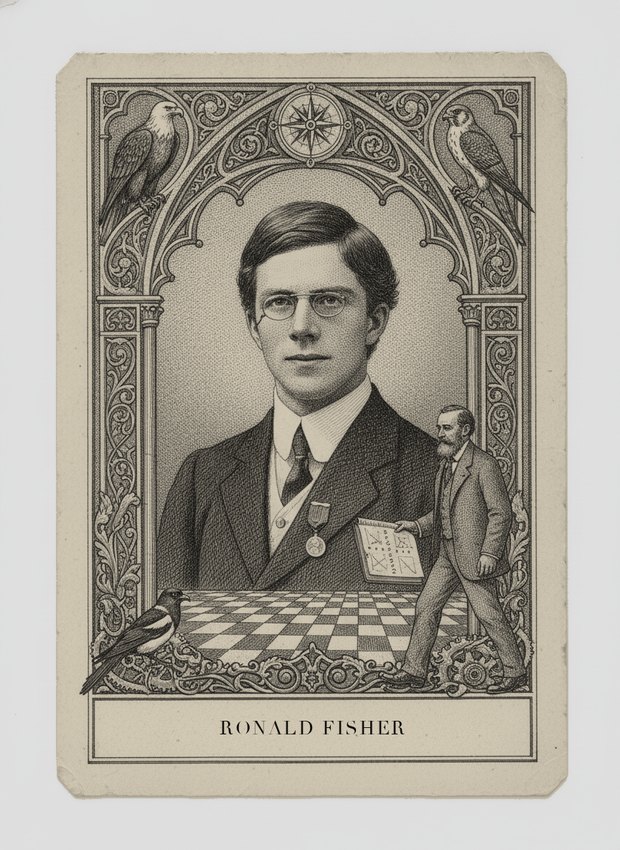
Fisher's maximum likelihood estimation and his rigorous treatment of small-sample inference (1920s) give exactly the machinery for extracting a best estimate of a physical constant from a few dozen imprecise measurements and attaching a principled error to it. His insistence on not discarding inconvenient data without justification, central to his experimental-design philosophy, speaks directly against Millikan's historically documented practice of quietly excluding disagreeing drops. He arrives shortly after the 1913 oil-drop experiment itself and generalizes exactly the estimation problem it poses, making him an extremely strong, if slightly retrospective, fit.
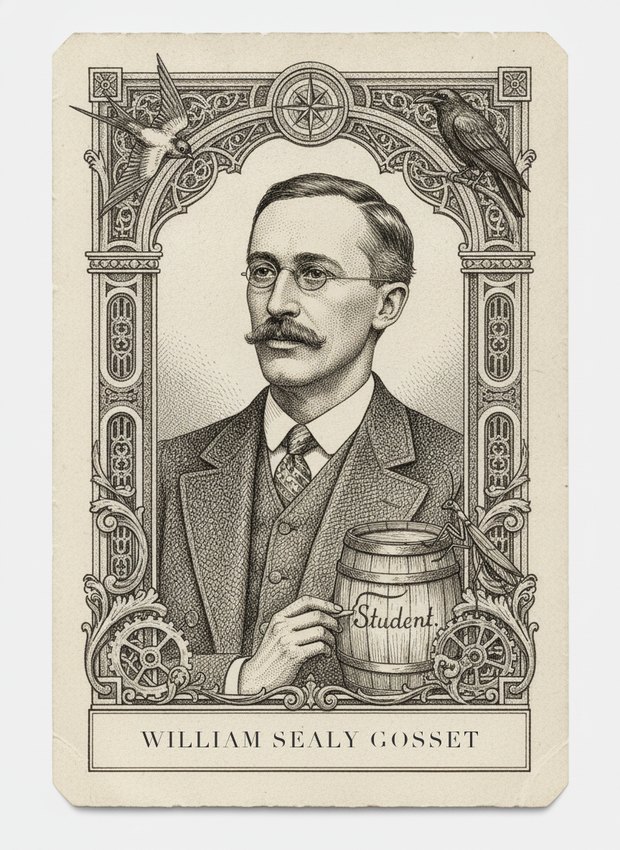
Gosset faced this regime a decade before anyone else on this roster took it seriously as a formal problem. As Guinness's brewer-statistician he had to draw honest conclusions from small, expensive batches of barley and hops trials, and his 1908 paper 'The Probable Error of a Mean,' published pseudonymously as 'Student,' derived the t-distribution because normal-theory standard errors quietly lie about how much certainty a handful of observations can support — the exact failure this problem warns against when 'a spurious precision misdirects a decade of atomic physics.' Applied to a few dozen oil-drop measurements, his method gives an honestly fattened interval rather than an overconfident one, hand-computable with 1913-era arithmetic. He is docked only slightly: his tools address the honest-error half of the task; the estimation and outlier-resistance discipline belong more to Gauss, Laplace, and later Tukey.
In the mind map
The same ideas, as concepts rather than history — in John's ML knowledge map.
38 figures are scored on this problem. Draw it in a battle to see where you land.