experimental-design
Two nuisances, one square
It is the 1930s, and a highway department must compare five road-surface mixtures, but two sources of nuisance variation threaten the test at once: the stretch of road, since some see heavier traffic, and the season a section is laid. Vary the mixtures carelessly and the winner may simply be the one that happened to fall on the light-traffic stretches. Design the trial as a square that balances each mixture across both nuisance directions simultaneously, so their effects cancel and the mixture comparison stands clean. Get it wrong and a durable surface is rejected because it drew the hard stretches, or a weak one is adopted, and a decade of roads crumble early — the design must neutralize both nuisances with a fixed, small number of test sections.
Who this problem belongs to
The two figures whose methods fit it best, out of 46 in contention.
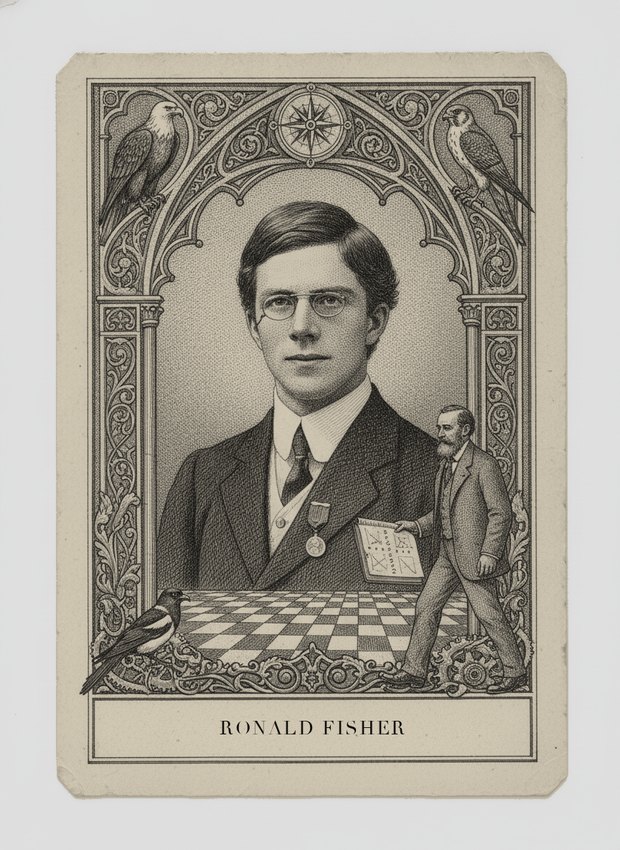
Fisher developed the Latin square design in exactly this context — agricultural field trials at Rothamsted during the 1920s, where soil fertility gradients ran in two directions and a naive layout would confound treatment differences with location. His solution, arranging treatments so each appears exactly once in every row and every column, neutralizes two nuisance directions simultaneously with a fixed, small number of plots, precisely the highway-mixture problem this question poses. He formalized the combinatorics and the accompanying analysis of variance in Statistical Methods for Research Workers and later The Design of Experiments. He is not a perfect 100 only because Latin square combinatorics predate him as pure mathematics; his contribution was making them a statistical design tool.
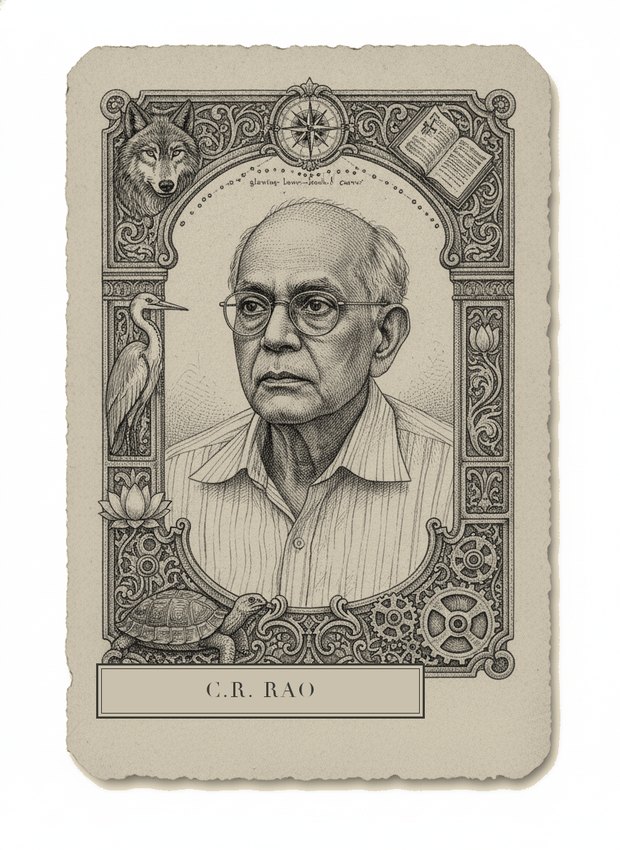
Rao's development of orthogonal arrays and combinatorial design theory, building on and generalizing the Latin square concept from the 1940s onward, extended Fisher's two-nuisance-factor solution to handle many more simultaneous nuisance dimensions with even fewer runs, using finite geometry and algebraic combinatorics to construct efficient designs Fisher's hand methods could not reach. For a highway department balancing exactly two nuisances with five mixtures, Rao's more general orthogonal-array machinery is more powerful than the problem strictly requires, but it subsumes the Latin square as a special case and would produce the correct design immediately. He is not the originator of the Latin square itself, which keeps him just below Fisher. That closeness to the method's historical origin is what keeps C.R. Rao among the stronger carriers in this particular batch.
In the mind map
The same ideas, as concepts rather than history — in John's ML knowledge map.
46 figures are scored on this problem. Draw it in a battle to see where you land.