experimental-design
Eleven factors, twelve runs
It is the early 1940s, and a wartime manufacturer suspects eleven different factors might affect the reliability of a component, with time and materials for barely a dozen test runs. Varying one factor at a time is hopeless — it would need far more runs than exist — so you must design a fraction of the full factorial that lets every factor's main effect be estimated from just twelve carefully chosen combinations. Spell out what this economy costs: which higher-order interactions become confounded with main effects, so you know what the screen can and cannot see. Get it wrong and you either demand runs you cannot afford, or read a confounded interaction as a main effect and chase the wrong factor into production.
Who this problem belongs to
The two figures whose methods fit it best, out of 42 in contention.
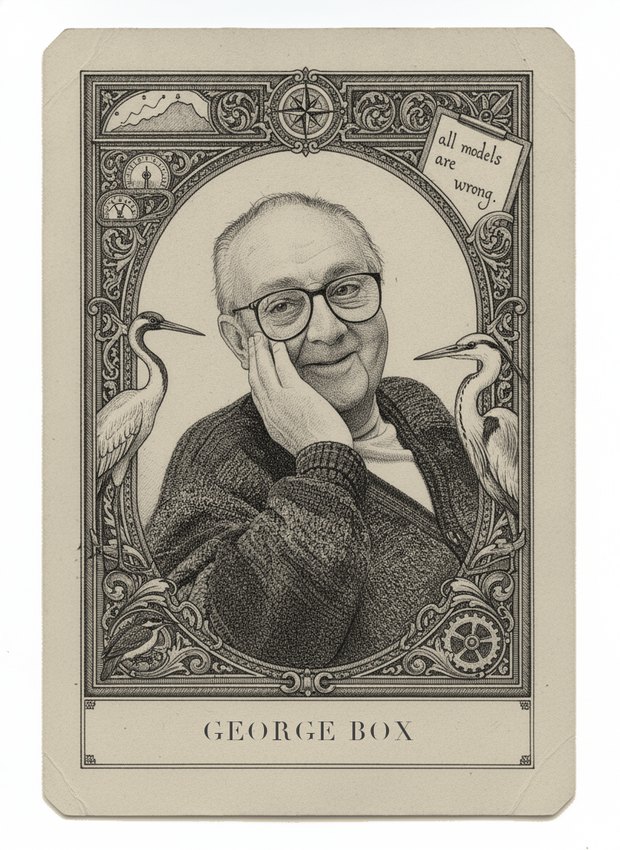
Box's decades-long partnership with J. Stuart Hunter on fractional factorial and screening designs, synthesized in their landmark Statistics for Experimenters, is built for exactly this wartime scenario: when a full factorial over eleven factors would require thousands of runs, a carefully chosen fraction — often built from Plackett-Burman-style constructions — lets every factor's main effect be estimated from a dozen or so combinations, at the explicit cost of confounding certain interactions with main effects. His entire applied statistics career was organized around specifying, in advance, exactly what such an economical design can and cannot see. He is not the absolute originator of fractional factorial theory, which is why the score falls just short of Fisher and Rao.
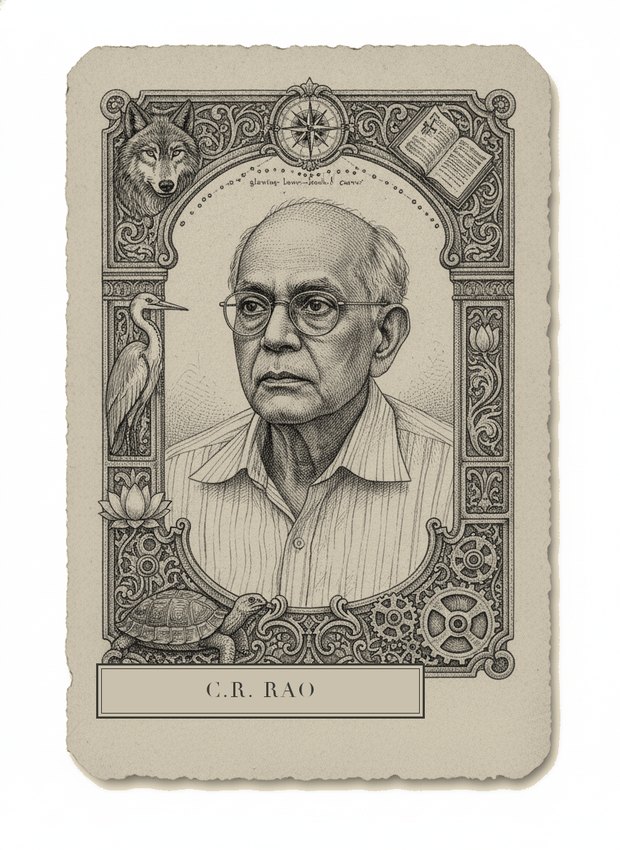
Rao's development of orthogonal arrays from the 1940s onward gave the general combinatorial theory underlying exactly this kind of economical screening design: a fixed small number of runs arranged so that every factor's effect can be estimated while explicitly tracking which interactions become aliased with which main effects. His mathematics generalizes and formally justifies the twelve-run designs — closely related to what Plackett and Burman independently constructed in 1946 for a nearly identical wartime manufacturing problem — that this scenario specifically requires. He is not the historical originator of the twelve-run Plackett-Burman construction itself, which keeps him just below Fisher and Box despite supplying the deeper combinatorial theory. That closeness to the method's historical origin is what keeps C.R. Rao among the stronger carriers in this particular batch.
In the mind map
The same ideas, as concepts rather than history — in John's ML knowledge map.
42 figures are scored on this problem. Draw it in a battle to see where you land.