experimental-design
Play the winner
It is 1969, and a statistician proposes a trial that feels almost too humane: as results come in, tilt the odds so that each new patient is more likely to be assigned whichever treatment is currently ahead, so fewer volunteers receive the losing therapy. But adaptive assignment tangles the analysis — the allocation now depends on past outcomes, so the usual tests no longer apply, and a run of early luck can bias the whole trial. Design the adaptive rule and the honest analysis that goes with it, balancing patient welfare against unbiased conclusions. Get it wrong and you either cling to fixed assignment and treat more patients with the inferior arm, or adapt sloppily and learn nothing trustworthy from the whole trial.
Who this problem belongs to
The two figures whose methods fit it best, out of 44 in contention.
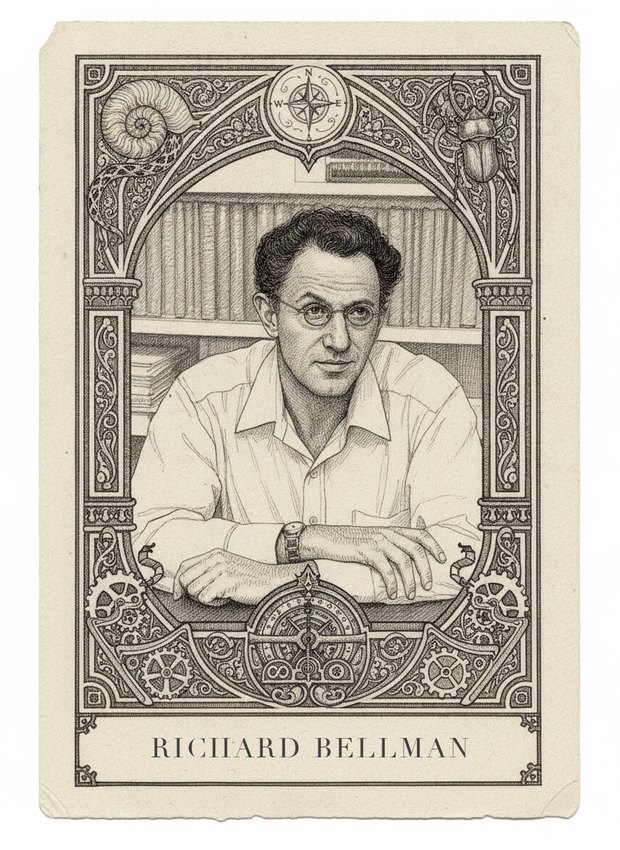
Bellman's dynamic programming (1957) is the mathematical machinery that eventually solved this exact problem class: adaptively allocating trials between competing options to maximize expected welfare while learning which is better, later formalized by Gittins as an optimal index policy built directly on Bellman's principle of optimality. In 1969, response-adaptive allocation was exactly the multi-armed-bandit structure his recursive value-function framework was built to handle -- balancing the expected gain of exploiting the currently-winning treatment against the value of further exploration. His curse-of-dimensionality warning also honestly flags why an exact optimal solution is hard even when the framework is right. The deduction is narrow: the specific closed-form Gittins-index solution for bandit problems arrived a few years after this 1969 scene, refining rather than replacing the dynamic-programming foundation Bellman had already laid.
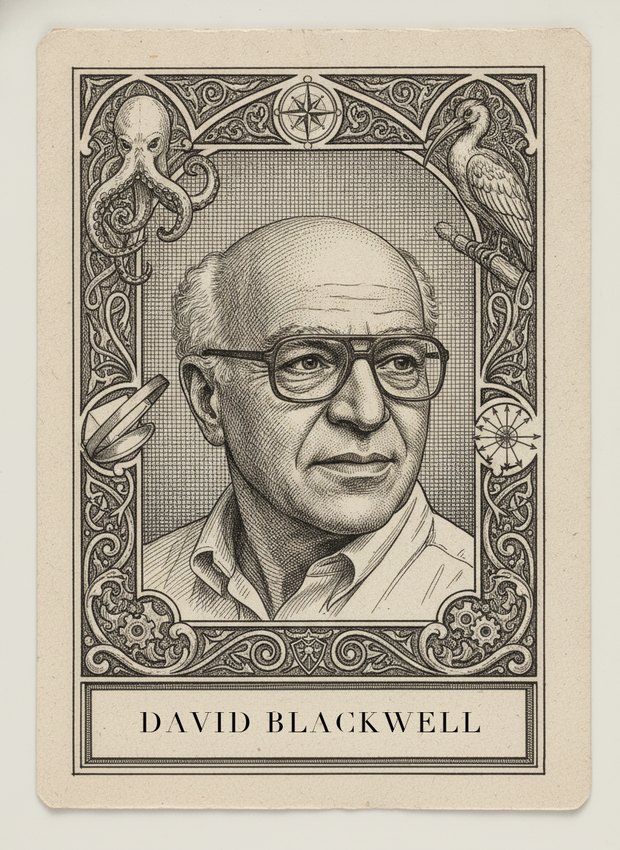
Blackwell's sequential decision theory and game-theoretic work, much of it done at RAND alongside the circle that produced Herbert Robbins's 1952 paper founding the sequential-design-of-experiments literature, put him at the mathematical center of exactly this problem: how to adapt an allocation rule as outcomes accumulate while still being able to draw valid conclusions. His and Girshick's Theory of Games and Statistical Decisions (1954) treats sequential experimentation and Bayesian updating with the rigor 'play the winner' requires, and Blackwell's own work on Bayesian sequential decision problems anticipates the adaptive-allocation logic directly. He sits just below Bellman because the specific bandit-allocation rule and its Gittins-index resolution were formalized by others slightly after his most concentrated work in this area, though his foundational apparatus underlies the whole field.
In the mind map
The same ideas, as concepts rather than history — in John's ML knowledge map.
44 figures are scored on this problem. Draw it in a battle to see where you land.