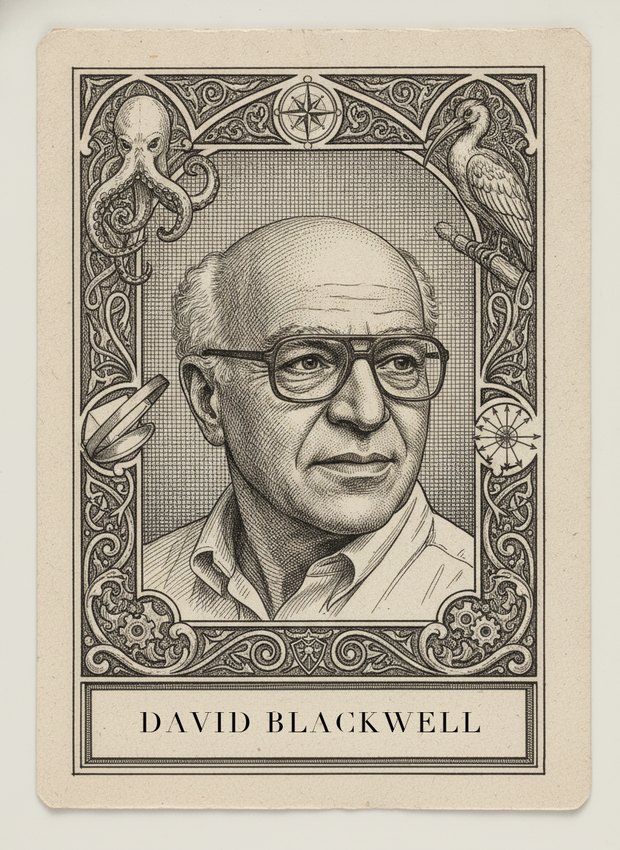
David Blackwell
Rao-Blackwell; games and decisions; first Black member of the NAS in math
Strongest on
In the mind map
The same ideas, as concepts rather than history — in John's ML knowledge map.
Life and career
David Harold Blackwell was born in Centralia, Illinois, in 1919, the son of a railroad worker. He entered the University of Illinois at sixteen intending to become an elementary-school teacher, discovered mathematics instead, and moved through the degrees at extraordinary speed — bachelor's in 1938, master's in 1939, and a PhD in 1941 at the age of twenty-two, under Joseph Doob, on Markov chains and the theory of martingale-like sequences. He was among the first Black Americans to earn a doctorate in mathematics.
What followed is a documented record of racial exclusion in American academia, and it belongs in any honest account of his career. Blackwell was awarded a Rosenwald Fellowship to the **Institute for Advanced Study** in Princeton, a position that customarily carried a courtesy appointment as a visiting fellow at Princeton University. The university objected — Princeton did not at that time admit Black students, and there was resistance to extending the affiliation to a Black mathematician. The IAS director, Frank Aydelotte, is documented as having pushed back on Princeton's position, and Blackwell did take up the fellowship. Blackwell himself, in later interviews, characterized his response to such episodes with striking equanimity, describing his job search of the period as simply a matter of applying to the institutions that would consider him — he wrote to every historically Black college in the country, over a hundred of them, because those were the realistic options available.
He was also considered for a position at the University of California, Berkeley, in the early 1940s and did not receive it; opposition on racial grounds from at least one senior figure is part of the documented account. Blackwell went instead to Southern University and then Clark College, and in 1944 to **Howard University**, the flagship Black university in Washington, D.C., where he spent ten years and became chair of the mathematics department. Howard in that era was one of the few places in America where a Black mathematician could build a career at all, and Blackwell built a substantial one there.
His research took a decisive turn through his contact with **Abe Girshick** at the RAND Corporation, where Blackwell consulted during summers. Girshick's work on sequential analysis and Wald's decision theory pulled Blackwell from pure probability into statistics and game theory. The RAND connection also drew him into dynamic programming and the mathematics of duels and pursuit games, which the defense-analysis community was then developing.
In 1954 Berkeley reversed itself, and Blackwell joined the statistics department — becoming, in 1956, its chair, and the first Black tenured professor at UC Berkeley. He remained there for the rest of his career, and Berkeley's statistics department became under his tenure one of the finest in the world. He supervised roughly sixty doctoral students. He was, by universal report, an exceptional lecturer: colleagues and students describe a classroom presence of remarkable clarity, in which complicated arguments were presented as though they were obvious, which is the hardest kind of teaching to do.
In 1965 he became the **first Black member of the National Academy of Sciences in mathematics**. He was president of the Institute of Mathematical Statistics, a vice president of the American Mathematical Society and the American Statistical Association, received the von Neumann Theory Prize in 1979, and was awarded twelve honorary doctorates. The R. A. Fisher Lectureship came to him in 1986. He died in 2010, at ninety-one. The Blackwell–Tapia Prize, honoring him alongside Richard Tapia, recognizes mathematicians who have contributed to diversity in the field.
Key contributions
**The Rao–Blackwell theorem.** Blackwell arrived at this result independently of C. R. Rao in 1947, and it is the piece of his work every statistics student meets. Suppose $\delta(X)$ is any unbiased estimator of $\theta$, and $T$ is a sufficient statistic for $\theta$. Define $\delta^*(T) = E[\delta(X) \mid T]$. Then $\delta^*$ is also unbiased, and by the law of total variance, $\mathrm{Var}(\delta^*) \leq \mathrm{Var}(\delta)$, with equality only if $\delta$ was already a function of $T$.
The reason this is beautiful rather than merely useful is what it says about sufficiency. Conditioning on a sufficient statistic does not require knowing $\theta$ — that is precisely what sufficiency means — so the operation is executable. And it never hurts. You can take a crude, obviously-wasteful estimator, "Rao-Blackwellize" it, and get something provably at least as good. Combined with the Lehmann–Scheffé theorem (if $T$ is complete as well as sufficient, the result is the *unique* minimum-variance unbiased estimator), it turns estimator construction into an algorithm. Modern echoes are everywhere: Rao-Blackwellized particle filters in robotics and state estimation marginalize analytically over the tractable components of the state to reduce Monte Carlo variance, and variance-reduction strategies throughout computational statistics and reinforcement learning are the same idea in different notation.
**Blackwell's approachability theorem.** This 1956 result is Blackwell's deepest and, for a modern ML audience, his most surprising. Consider a repeated game with vector-valued payoffs against an adversary. Ask: for which target sets $S$ in payoff space can a player guarantee that the long-run average payoff vector converges to $S$, regardless of what the opponent does? Blackwell gave a complete geometric characterization — roughly, $S$ is approachable if for every point outside it, the player has a strategy making the expected payoff lie on the far side of the hyperplane separating that point from its projection onto $S$ — together with a constructive strategy.
The theorem generalizes von Neumann's minimax theorem to vector payoffs, and it turned out decades later to be the engine of **online learning**. No-regret learning is approachability: define the vector payoff to be the vector of regrets against each action, take $S$ to be the negative orthant, and an approachability strategy is precisely a no-regret algorithm. Modern results on calibration, on internal and swap regret, on equilibrium computation in extensive-form games, and on the counterfactual-regret-minimization algorithms behind superhuman poker play all descend from this line. Blackwell was doing online learning theory in 1956.
**Comparison of experiments and the Blackwell order.** Blackwell formalized what it means for one statistical experiment to be more informative than another: experiment $A$ is *sufficient* for (dominates) experiment $B$ if $B$'s observations can be produced by garbling $A$'s through a stochastic transformation. The theorem is that this holds if and only if $A$ yields at least as good a result for every decision problem and every loss function. This is a foundational result in information economics and decision theory, and its logic recurs wherever one must rank data sources without reference to a particular downstream task — including in modern discussions of experiment design and information value.
**Dynamic programming and Bayesian decision theory.** Blackwell's work on dynamic programming, notably the discounted infinite-horizon case, established conditions under which optimal stationary policies exist — the Blackwell optimality criterion and the contraction structure of the Bellman operator are standard equipment in reinforcement learning theory. His book with Girshick, *Theory of Games and Statistical Decisions* (1954), synthesizes Wald's decision theory with game theory and remains readable. He also worked on martingales, merging of opinions, and Bayesian sequential analysis, arguing the Bayesian case with characteristic mildness in a strongly frequentist era.
In battle
Blackwell has the strongest and most balanced card of the sixteen figures here. He carries 101 problems at a mean of **47.4**, median 42, with **fourteen** dominant problems, **twenty** at 70 or above, and only **ten** at or below 20 — a fraction of the weak-problem count of any systems figure in this set. His category card is broad: **games** 73.2, **rl** 66.7, **small-sample** 61.1 across fourteen problems, **fairness** 55.7, **information** 55.5, **testing** 54.4 across thirteen, **causality** 51.8 across thirteen, **optimization** 49.5, and **experimental-design** 47.3 across sixteen. He has no category below 20.
His ceiling problem is **P106, "Squeeze the estimator dry"** (95) — Rao–Blackwellization itself, taking a crude small-sample estimator, conditioning it on a sufficient statistic, and certifying it against the variance floor. **P210, "Find the lost submarine"** (92) is Bayesian search theory, where sequential posterior updating and optimal stopping are directly his machinery. **P120, "Play the winner"** (88) is adaptive clinical-trial allocation — a bandit problem, and the approachability and dynamic-programming apparatus is exactly right for it. **P123, "Signal or just noise?"** (88) is the Neyman–Pearson lemma and detection theory, squarely within his decision-theoretic toolkit. **P218, "Thirty percent chance of rain"** (85) is probability calibration, which connects directly to his approachability work — calibration is an approachability result. **P061, "The hierarchy of hospitals"** (83) is hierarchical Bayesian modeling; **P103, "Count the fish you cannot see"** (83) is capture–recapture estimation; **P003, "Estimate the tank total"** (82) is the German tank problem, a pure minimum-variance-unbiased-estimation exercise that Rao–Blackwell and Lehmann–Scheffé solve outright.
His losses are few and instructive. **P143, "The coefficient that flips sign"** (9) is his floor — confounding, mediation, and collider bias. This is a genuinely interesting weakness: Blackwell is superb at estimator *efficiency* but the Pearl/Rubin causal-structure machinery is a separate tradition that postdates most of his work, and knowing the variance floor tells you nothing about whether you conditioned on the right variables. **P142, "Predict the ore grade underground"** (10) is kriging and geostatistics; **P240, "Cut the image into things"** (15) and **P273, "Cut the image, weight the graph"** (18) are image segmentation, requiring computer-vision methods entirely outside his record; **P157, "The equation with no algorithm"** (16) is numerical PDE work; **P140, "The ruler that lies a little"** (18) is measurement-error modeling. His `perception` average of 20.0 is his lowest category.
The strategic read: Blackwell is the best generalist in this group. He is nearly loss-proof — only ten weak problems out of 101 — and dominant across statistics, decision theory, sequential analysis, and repeated games. His stated identity is right that he loses only on brute empiricism: where the answer comes from pixels, ore samples, or messy measurement rather than from a decision-theoretic argument, elegance has nothing to grip. Everywhere else, he improves whatever estimator you hand him.