testing
Catch the process the moment it drifts
It is 1954, and a factory's production line runs on target for now — but somewhere ahead a tool will wear, a setting will slip, and the output will drift out of spec, and you must detect that shift as soon as it happens without crying wolf while all is well. A fixed test on each item is too slow or too jumpy; instead accumulate the running evidence of a shift so small persistent deviations build up and trigger an alarm quickly, while random noise cancels out. Design the rule and its trade-off: how fast it catches a real shift against how often it false-alarms on a stable process. Get it wrong and defective product ships for hours undetected, or the line is stopped constantly for phantom shifts.
Who this problem belongs to
The two figures whose methods fit it best, out of 54 in contention.
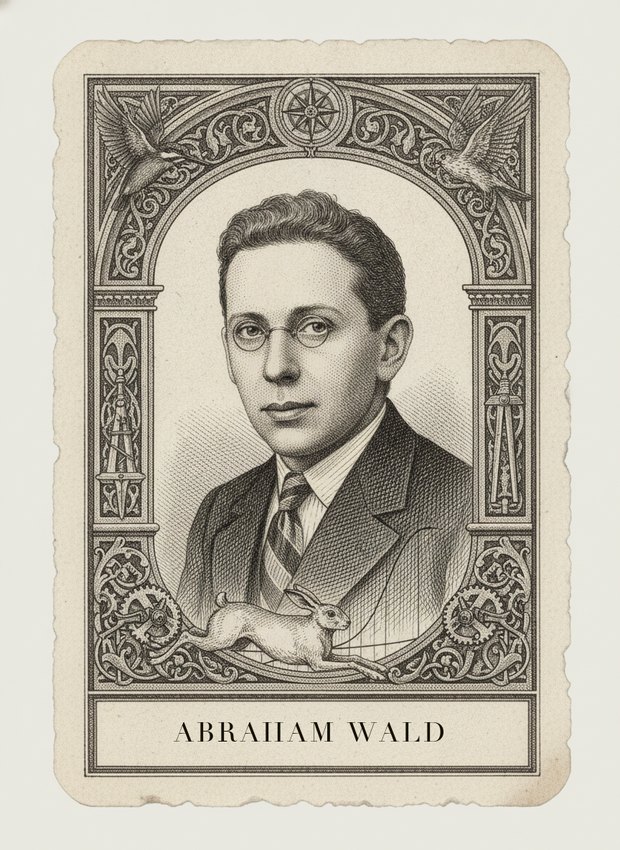
This problem's entire mathematical engine is Wald's. His sequential probability ratio test, developed from 1943 for the Statistical Research Group, established the theory of accumulating evidence observation by observation and triggering a decision the moment accumulated evidence crosses a threshold, trading off detection speed against false-alarm rate in a provably optimal way. The specific procedure this factory scenario needs — a cumulative sum that resets on non-shifts and alarms on sustained drift — was formalized by Page in 1954 as a direct engineering descendant of Wald's sequential testing theory, built explicitly on the SPRT's logic of running log-likelihood-ratio accumulation. Wald did not build the CUSUM chart himself, which is why he falls short of a perfect score, but every piece of its mathematical machinery is his, applied to a manufacturing line instead of a wartime interrogation.
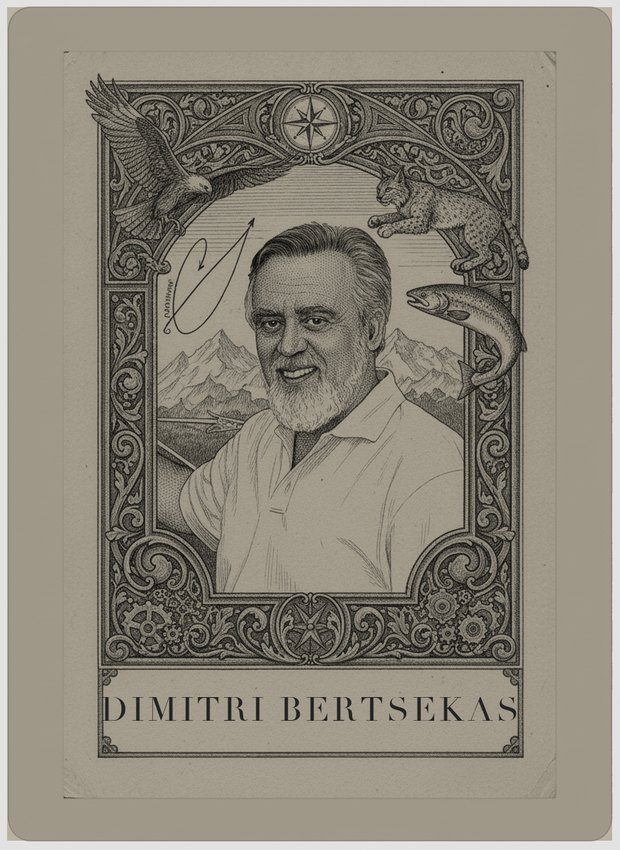
Bertsekas's lifelong research program on dynamic programming and optimal control, developed from the 1970s onward, treats exactly this problem's structure as a canonical example: a process evolving over time whose state must be inferred and acted upon as quickly as possible once it drifts from a target regime, balancing the cost of delayed detection against the cost of false alarms. His neuro-dynamic programming work extends this into settings where the optimal stopping and detection rule must be learned or approximated rather than solved in closed form. He does not outrank Wald because the specific sequential change-detection theory this 1954 factory scenario calls for was established slightly earlier by Wald and Page, whose sequential-testing framework Bertsekas's later optimal-control treatment formalizes and extends rather than originates.
Fought here
In the mind map
The same ideas, as concepts rather than history — in John's ML knowledge map.
54 figures are scored on this problem. Draw it in a battle to see where you land.