computability
Trust without recomputing
It is the 1980s and 90s, and a strange power is discovered: a computationally limited verifier can become convinced of a claim it could never check itself, by interrogating a powerful but untrusted prover through rounds of random challenges. Formalize interactive and probabilistically checkable proofs, and pin down their astonishing reach — that with interaction and randomness, the set of verifiable statements swells enormously, and that a written proof can be spot-checked at a few random places to catch any flaw with high probability. The definitions are the achievement. Get them wrong and you either trust an untrustworthy prover, or fail to see that verification can be radically cheaper than discovery — a gap grounding modern cryptography and delegated computation.
Who this problem belongs to
The two figures whose methods fit it best, out of 46 in contention.
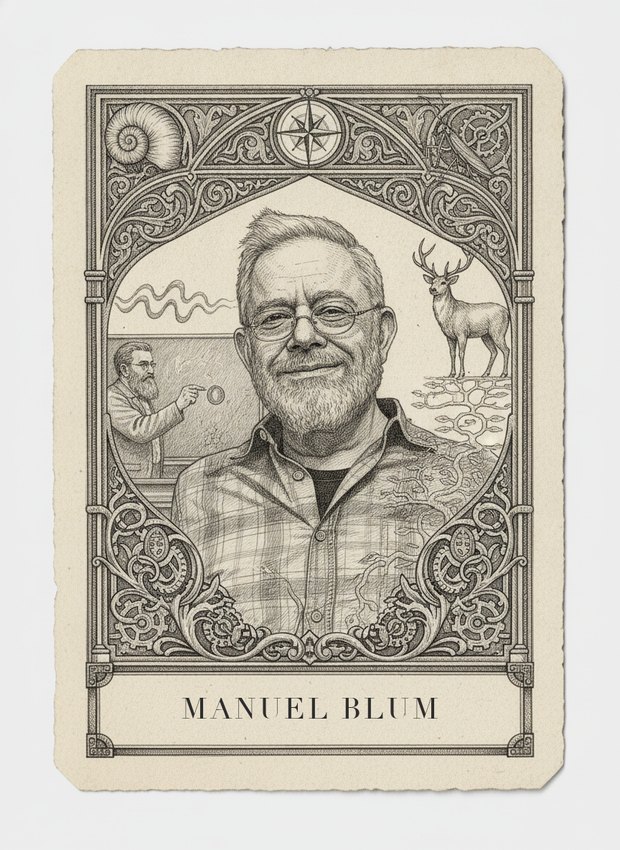
Blum stands close to the center of this problem's actual history: his mid-1980s work with Shafi Goldwasser and others on interactive proofs and zero-knowledge protocols helped establish the very framework this problem asks for, where a computationally limited verifier gains confidence in a powerful, untrusted prover's claim through randomized challenge-and-response rounds. His broader career in computational complexity, including his axiomatic complexity measures and his invention of the CAPTCHA — itself a practical interactive proof that a party is human — shows a sustained, career-long engagement with exactly this family of ideas. As a Berkeley theorist and advisor to many of the field's leading researchers, Blum is not merely adjacent to this result but genuinely embedded in its founding tradition.
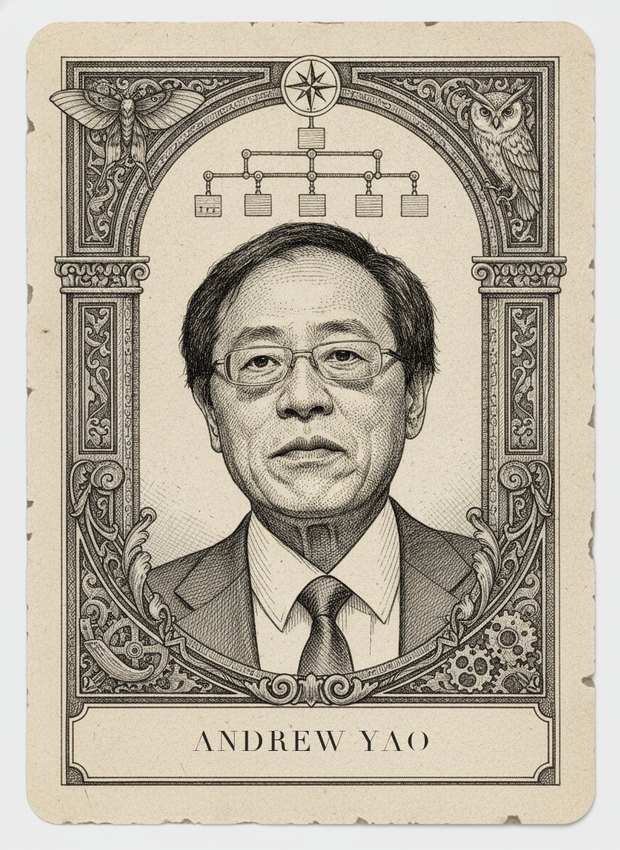
Yao's foundational complexity-theoretic work from the 1970s and 80s, including his studies of communication complexity and his minimax principle for randomized algorithms, sits squarely in the tradition that produced interactive and probabilistically checkable proofs. His broader contributions to theoretical cryptography and secure multiparty computation, where two parties must be convinced of a computation's correctness without revealing everything, are close conceptual siblings of interactive proof systems, sharing the core idea that structured interaction under randomness can establish trust cheaply. Working contemporaneously with the interactive-proof pioneers of the 1980s, Yao did not author this specific theorem, but his entire research program treats randomized verification and adversarial interaction as central objects, making him an outstanding fit.
Fought here
In the mind map
The same ideas, as concepts rather than history — in John's ML knowledge map.
46 figures are scored on this problem. Draw it in a battle to see where you land.