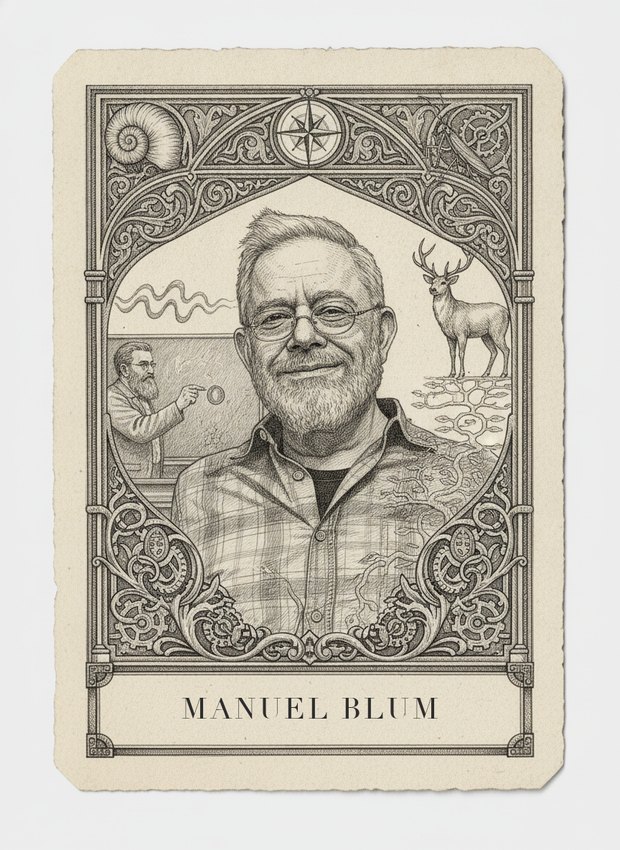
Manuel Blum
Computational complexity; CAPTCHAs; advisor of a generation
Strongest on
Life and career
Manuel Blum was born in Caracas, Venezuela, in 1938, the child of Jewish emigrants who had left Europe. He came to the United States for university and entered MIT, where he encountered two of the most consequential mentors available to a young person interested in machines that think: Warren McCulloch, the neurophysiologist who with Walter Pitts had modeled neurons as logical units, and Marvin Minsky, who supervised his doctoral work. Blum's early interest was in what a brain, considered as a computing device, could and could not do — a question that in the early 1960s had no settled vocabulary. He received his PhD from MIT in 1964 and joined the faculty at the University of California, Berkeley, where he spent roughly three decades and helped make Berkeley one of the world's centers of theoretical computer science.
The Berkeley years are where the legend accumulates. Blum's dissertation and immediately subsequent work founded what became known as abstract, or axiomatic, complexity theory — an attempt to say what "the cost of computing" means without committing to any particular machine model. But he is at least as famous for something less formalizable: he was an extraordinary advisor. The list of doctoral students who passed through his office reads like a roll call of the field's leadership over the following decades, including researchers who went on to win the Turing Award themselves. Colleagues have described his advising style as relentlessly Socratic and disarmingly patient — he would let a student explain something badly for a long time before asking the one question that unmade it. His academic family tree, traced through students and their students, is one of the largest and most influential in computer science.
Blum married Lenore Blum, a mathematician and computer scientist in her own right, known for work on complexity over the real numbers and for decades of advocacy for women in mathematics and computing. Their son, Avrim Blum, became a prominent machine-learning theorist. The three of them constitute one of the more remarkable research families in the discipline, and they have on occasion collaborated.
In 1995 Blum received the ACM Turing Award, the field's highest honor, cited for contributions to the foundations of computational complexity theory and its application to cryptography and program checking. Not long after, he and Lenore moved to Carnegie Mellon University, where he continued to work on cryptographic protocols, program checking, and the problem that would give him his most famous public artifact: distinguishing humans from programs online. In later years his research turned toward a formal theory of consciousness, developed with Lenore — an attempt to specify, in the language of theoretical computer science, what architecture a "conscious" machine would need. It is a characteristically Blum move: take a question everyone treats as philosophy and ask what a Turing machine would have to look like for it to be true.
Key contributions
**Axiomatic complexity theory.** Blum's earliest major result asked a foundational question: can we talk about computational cost in general? He proposed a set of axioms that any reasonable complexity measure must satisfy — essentially, that the cost of a halting computation is defined and finite, and that it is decidable whether a given computation costs a given amount. Running time and memory both satisfy these axioms, but so do many other measures. Working inside this abstraction, he proved two celebrated results. The **Blum speedup theorem** shows that there exist computable functions with no best algorithm: for any program computing such a function, there is another program that is arbitrarily faster on all but finitely many inputs. This is genuinely disturbing — it means "the optimal algorithm for this problem" is not always a meaningful phrase. The **gap theorem**, with related results, shows that there are resource bounds between which no new functions become computable at all, so the complexity hierarchy is not uniformly well behaved. Together these results delimit how much structure one can expect from a general theory of efficiency, and they remain the reason complexity theorists work with concrete measures on concrete machine models rather than in full generality.
**Cryptographic protocols and randomness.** In the late 1970s and early 1980s Blum became a central figure in the new science of cryptographic protocols. His "coin flipping by telephone" protocol posed and solved a problem that sounds like a puzzle and turns out to be foundational: two mutually distrustful parties who cannot see each other must agree on a random bit, such that neither can bias the outcome. The solution — commit first to a value in a way that hides it but cannot later be changed, then reveal — introduced the **bit-commitment** primitive that underlies an enormous amount of later protocol design. With Silvio Micali he developed the Blum–Micali pseudorandom generator, showing how to stretch a short secret seed into a long sequence that no efficient adversary can distinguish from true randomness, with security reduced to the presumed hardness of the discrete logarithm. With Lenore Blum and Michael Shub he gave the Blum–Blum–Shub generator, whose unpredictability rests on the hardness of factoring integers of a special form. These constructions embody the defining idea of modern cryptography: computational hardness is not an obstacle to be defeated but a resource to be spent.
**Interactive proofs and zero knowledge.** Blum was part of the circle — with Shafi Goldwasser, Silvio Micali, and others — from which interactive and zero-knowledge proofs emerged in the mid-1980s. The framework replaces the classical static proof with a conversation: a computationally limited verifier fires random challenges at a powerful, untrusted prover and, after a few rounds, is convinced with overwhelming probability, while learning nothing beyond the truth of the claim. This reframing of what "proof" means is one of the deepest conceptual moves in theoretical computer science, and it is the direct ancestor of today's verifiable-computation and succinct-proof systems.
**Program checking.** Blum also asked a practical version of the same question: if you do not trust a program, can you cheaply check its output without recomputing it? Program checkers and self-testing/self-correcting programs, developed by Blum with Sampath Kannan and others, produce probabilistic guarantees that a particular run was correct. The idea is the operational sibling of interactive proofs, and it seeded the field of property testing.
**CAPTCHAs.** At Carnegie Mellon, Blum with Luis von Ahn and colleagues formalized the CAPTCHA: a puzzle easy for humans and hard for programs, deployed to keep automated agents out of systems built for people. Its intellectual content is genuinely Blumian — it is a proof of humanity, an interactive protocol whose soundness rests on an open AI problem, and it converts the *failure* of artificial intelligence into a usable security guarantee.
In battle
Blum's computed profile is that of a hardness specialist. His strongest category by a wide margin is **computability** (66.3 across sixteen problems), followed by **information** and, more surprisingly, **high-dimensional** questions where randomization and hashing carry the argument. He carries 101 problems with a mean of 35.9 — a spiky, opinionated distribution rather than a broad one.
Where he dominates, he dominates on his own turf. His single best problem is **P164, "Trust without recomputing"** (92) — the interactive-proof and program-checking question that he helped invent twice over, once as protocol theory and once as CAPTCHA. **P162, "More time, strictly more power"** (91) is the time-hierarchy question, and Blum's abstract complexity axioms are exactly the machinery for reasoning about when more resource buys more power — and, via the gap theorem, when it does not. **P159, "Is this number prime?"** (88) plays to his randomized-algorithms and number-theoretic-cryptography instincts; **P170, "The message no eavesdropper can read"** (85) is straight cryptographic protocol design. **P163, "The fastest-growing function"** (80) is the speedup theorem's neighborhood. He is also strong on **P030, "Will it ever halt?"** (78), **P031, "Is there a fast route through every city?"** (76), and **P033, "The shortest description"** (72) — Kolmogorov complexity being a natural fit for someone whose career is about measuring the cost of computation in the abstract.
His losses are equally legible, and pedagogically the more interesting half. Blum collapses on classical statistics. **P108, "Estimating many means at once"** (5) — the James–Stein shrinkage problem — is his floor, and the game's own explanation is blunt: nothing in his published work touches decision-theoretic admissibility, empirical Bayes, or variance-bound estimation. **P133, "Why tall fathers have shorter sons"** (6, regression to the mean), **P137, "The same patients, measured again and again"** (6, repeated measures), and **P118, "The factor you can't keep changing"** (6, split-plot design) are all cases where the required toolkit is experimental design and linear models — a tradition Blum simply never worked in. **P124, "Twenty thousand tests at once"** (8) is instructive because it *looks* like it should suit him: massive multiplicity, a combinatorial flavor. But false-discovery-rate control is a statistical inference problem, not a complexity one, and his regression category average of 6.0 confirms the pattern.
The lesson for a student picking Blum: he is a scalpel. Send him at anything where the answer is "this is hard, and here is how to exploit or certify that hardness" and he is nearly unbeatable. Send him at anything requiring you to estimate a parameter from noisy data and he has nothing to say. His `rl` (16.0), `testing` (14.0), `classification` (14.0), and `small-sample` (10.0) averages are all in the basement. Thirty-one of his 101 problems score at or below 20. He is a high-variance pick — the right opponent-specific weapon, not a generalist.