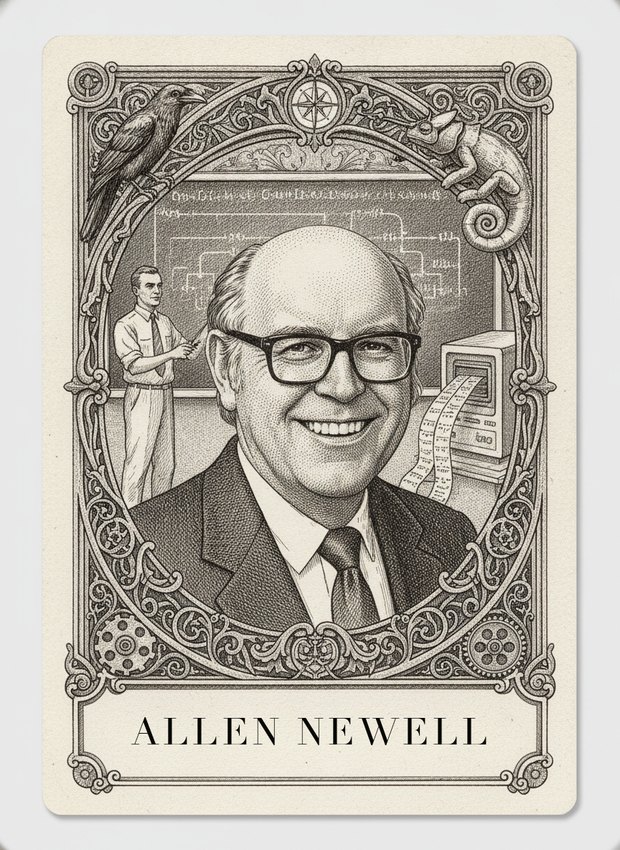
Allen Newell
Symbolic problem solving; cognitive architectures (with Simon)
Strongest on
In the mind map
The same ideas, as concepts rather than history — in John's ML knowledge map.
Life and career
On a December afternoon in 1955, Allen Newell, Herbert Simon, and the programmer Cliff Shaw were hand-simulating a program by having Simon's family and graduate students each act as a subroutine, passing index cards. The program was the Logic Theorist, and when it ran on RAND's JOHNNIAC the following year, it proved thirty-eight of the first fifty-two theorems in Chapter 2 of *Principia Mathematica* — one of them, famously, by a shorter route than Whitehead and Russell had found. Simon told his class that January that over the Christmas holiday he and Newell had "invented a thinking machine." He was overstating, but not by as much as it sounds.
Newell was born in San Francisco in 1927, the son of a Stanford radiology professor. He served in the Navy at the end of the war — assigned, as it happened, to map radiation levels at Bikini Atoll after the atomic tests — took his physics degree at Stanford in 1949, spent a year in mathematics at Princeton, and then left for the RAND Corporation, where the decisive encounter of his life occurred. At RAND he worked on air-defense simulations, watching human operators track aircraft, and became convinced that the interesting object of study was the *information processing* the operators were doing. There he met Herbert Simon, then a political scientist working on organizational decision-making, and formed one of the most productive partnerships in the history of the field. It lasted, by both men's account, essentially without friction until Newell's death.
Newell took his PhD at Carnegie Tech in 1957 under Simon, in what was then industrial administration, and joined the faculty. He spent the rest of his career at Carnegie Mellon, where he, Simon, and Alan Perlis built the computer science department — one of the first in the world — and where he trained a long line of students. He was a physically large, relentlessly energetic presence, known for talking through problems at a pace that exhausted collaborators and for an unusual insistence that a scientist should pick one hard problem and work on it for decades. His own choice was the architecture of the mind.
Newell and Simon shared the Turing Award in 1975. Newell received the National Medal of Science in 1992. Diagnosed with cancer, he spent his final year finishing *Unified Theories of Cognition*, the book that stated his lifelong argument in full, and died in Pittsburgh in 1992 at sixty-five. The ACM–AAAI Allen Newell Award is named for him.
Key contributions
**The Logic Theorist (1956)** and **the General Problem Solver (1957–59)** are the first two AI programs in any meaningful sense, and their significance is methodological. Logic Theorist showed that theorem-proving could be recast as *search through a space of expressions* under inference-rule operators, guided by heuristics that prune the astronomically large space to a tractable one. GPS generalized the machinery to any domain expressible as states, operators, and a difference function, and introduced **means–ends analysis**: compare the current state to the goal, identify the largest difference, select an operator known to reduce that kind of difference, and recurse on the subgoal of making that operator applicable. This is the ancestor of every planner that reasons backward from goals, and it is still the clearest single algorithmic statement of what "problem solving" might mean.
To build these programs Newell and Shaw had to invent the infrastructure: **IPL**, the Information Processing Language, introduced list processing, dynamic memory allocation, and recursion into practical programming — several years before LISP, which absorbed and improved on the ideas. Newell also contributed early to the development of **production systems**, in which knowledge is encoded as condition–action rules matched against working memory, a formalism that became the backbone of expert systems and of much of cognitive modeling.
**Human Problem Solving (1972, with Simon)** is the empirical counterpart. Using protocol analysis — recording subjects thinking aloud while solving cryptarithmetic, logic, and chess problems, then coding the transcripts — Newell and Simon argued that human problem solving is search through a problem space, constrained by a small working memory and slow long-term storage. The book's methodological contribution, taking verbal protocols seriously as data about internal processing, remains contested but influential; its theoretical contribution, the problem-space hypothesis, structured cognitive psychology for a generation.
**The physical symbol system hypothesis** (stated in their 1975 Turing Award lecture) is the philosophical core: a physical symbol system has the necessary and sufficient means for general intelligent action. It is a strong, falsifiable-in-principle claim, and it defined the terms of the symbolic-versus-connectionist argument for decades. Whatever one concludes about it now, it is the clearest thesis anyone in AI has ever put on the table.
**Soar** (from the early 1980s, with John Laird and Paul Rosenbloom) was Newell's answer to his own late-career complaint that psychology was producing microtheories of isolated phenomena and never assembling them. Soar is a **unified cognitive architecture**: all long-term knowledge is production rules, all activity is problem-space search, and every impasse — every point where the system cannot decide what to do — automatically spawns a subgoal, whose resolution is compiled back into a new rule by a mechanism called **chunking**. Chunking gives Soar a learning mechanism that reproduces the power law of practice, one of the most robust quantitative regularities in psychology. Newell's 1987 William James Lectures, published as *Unified Theories of Cognition* (1990), argue that the field's obligation is to build such candidate theories and test them against the full range of human data, from millisecond reaction times up to hours-long problem solving.
In battle
Newell's numbers describe a specialist with an unusually deep specialty. Mean 26.3, median 18, but six problems above 80 — the most dominant scores of anyone in the symbolic AI cohort — and a `search` category mean of 62.4 across sixteen problems, the highest single-category figure in his profile by a wide margin. If a problem can be posed as "explore a space of states under operators, guided by a heuristic," Newell is close to the best answer the roster has.
His signature score is 96 on **Let the machine find the proof** (P195). This is not analogy; the problem describes the Logic Theorist almost exactly — *Principia* axioms, a searched space of derivations, proofs found for theorems in Chapter 2, presented at Dartmouth in 1956. No one else on the roster fits that framing. **Sequence the robot's actions** (P190) at 90 and **Color the map, meet the constraints** (P188) at 85 follow from GPS and means–ends analysis: planning and constraint satisfaction are the direct descendants of his operator-and-subgoal machinery. **The robot in the warehouse** (P047) at 84 and **Shortest path through the map** (P046) at 73 reward the same state-space discipline applied to physical navigation. **The imitation game, scored** (P259) at 83 places him among the small group who defined what machine intelligence would even mean. **Prune the adversary's replies** (P194) at 80 is game-tree search, where his and Simon's early chess programs were foundational. **The heuristic that never lies** (P191) at 65 — admissible heuristics and A\* — is arguably the purest expression of his research program, though the algorithm itself belongs to Hart, Nilsson, and Raphael.
The losses are severe and instructive. He scores 5 on **Trained here, deployed there** (P153) — distribution shift, a problem that presupposes a learned statistical model — 5 on **The posterior at web scale** (P213) and **The paradox in the admissions data** (P214), 4 on **The therapy the trial reversed** (P215) and **Calculus for a jagged path** (P216), and 3 on **How high must the dike be?** (P217). His weak categories tell the same story numerically: regression 6.0, information 7.0, experimental-design 8.0, high-dim 10.0, classification 13.2 over seventeen problems.
The reason is not incidental to his career; it is his career's central bet. Newell held that intelligence is symbol manipulation, and he built architectures accordingly — discrete states, discrete operators, discrete rules. Nothing in that machinery represents a probability distribution, and nothing in it learns from noisy data except by compiling successful search episodes into new rules. Chunking is a learning mechanism, which is why his `rl` mean of 25.5 is not zero, but it learns from *solved problems*, not from samples. Against a statistician on any question involving uncertainty, confounding, or generalization, Newell has nothing to deploy.
Play him on planning, theorem proving, constraint satisfaction, pathfinding, and game search, and he is one of the strongest cards available. Play him on data and he loses to people whose names appear in no AI textbook.