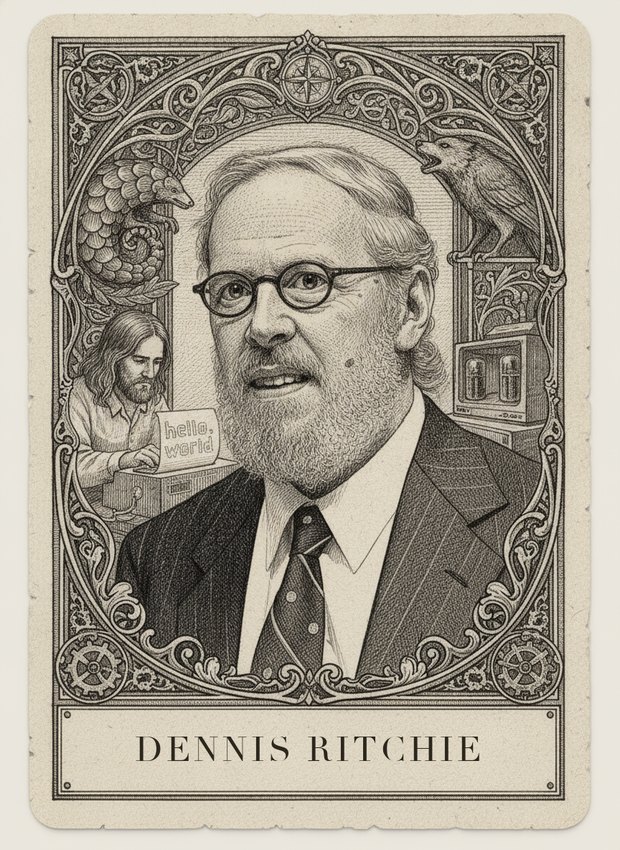
Dennis Ritchie
C and Unix
Strongest on
Life and career
Dennis MacAlistair Ritchie was born in Bronxville, New York, in 1941, and grew up in New Jersey. His father, Alistair Ritchie, was a scientist at Bell Telephone Laboratories and co-author of a book on switching circuit theory — so Dennis came to Bell Labs partly as a family inheritance. He studied at Harvard, taking a degree in physics and then working toward a doctorate in applied mathematics; his thesis concerned subrecursive hierarchies of functions, a topic in recursion theory. He is generally reported to have completed the work but never formally received the degree, a detail he seems to have found unremarkable. In 1967 he joined Bell Labs' Computing Sciences Research Center in Murray Hill.
The Labs at that moment had just extricated itself from **Multics**, the ambitious MIT-GE-Bell time-sharing system that had grown vast and slow. Bell Labs pulled out in 1969. What followed is one of the most consequential retreats in engineering history. Ken Thompson, with Ritchie and a small circle including Rudd Canaday, Doug McIlroy, and Joe Ossanna, set out to build a much smaller system on a scavenged PDP-7, keeping the good ideas from Multics — a hierarchical file system, a shell as an ordinary user program, devices as files — while discarding the complexity. McIlroy suggested the name Unix, a pun on Multics.
Ritchie's specific role was the language. Thompson had written a stripped-down language called B, derived from BCPL; Ritchie evolved it into **C**, adding a type system, structures, and the pointer machinery that made it possible to write systems code without dropping to assembly. In 1973 Unix was rewritten in C. This is the pivotal event: an operating system in a high-level language could be moved to new hardware by writing a compiler back end, rather than by rewriting everything. Unix went from a clever local artifact to a portable substrate, and it spread — first through universities, where AT&T's regulated status meant it was licensed cheaply, then everywhere.
Ritchie spent his entire career at Bell Labs, later heading the Systems Software Research department. He worked on Plan 9 and Inferno, research operating systems that pushed the "everything is a file" idea further than Unix ever did, and he contributed the stream I/O mechanism that shaped later Unix device drivers. With Brian Kernighan he wrote *The C Programming Language* in 1978 — "K&R" — a book of extraordinary compression that taught the language to a generation and made "hello, world" the universal first program.
He received the ACM Turing Award in 1983 with Thompson, the IEEE Richard W. Hamming Medal, and the U.S. National Medal of Technology. Colleagues describe him as quiet, dry, precise, allergic to self-promotion, and generous with his time. He died at home in October 2011, a week after Steve Jobs, and the disparity in public attention became its own small commentary on how the field values what it stands on. Every Unix and Linux system, every macOS and iOS device, every Android phone, and essentially every embedded system in existence runs code descended from his.
Key contributions
**The C programming language.** C's design goal was narrow and clearly held: give a programmer the expressive convenience of a high-level language while remaining close enough to the machine that no runtime system and no hidden cost are required. The result has a small set of orthogonal features — a handful of types, a pointer model in which arrays decay to pointers and pointer arithmetic is defined on them, structures, unions, functions with a simple call convention, and a preprocessor. There is no garbage collector, no bounds checking, no exceptions, and no runtime type information. The language does essentially nothing you did not ask for.
For a graduate audience the interesting property is C's role as a *contract with the compiler*. C is close enough to typical machine architecture that a competent programmer can predict roughly what code will be emitted, which is exactly what systems programming requires. That predictability is why C remains, half a century later, the implementation language of operating system kernels, device drivers, embedded firmware, language runtimes (including CPython), database engines, and numerical libraries. It is also the *lingua franca* of foreign function interfaces: when Python calls NumPy, or R calls a Fortran routine, or any two languages need to talk, they agree on the C ABI. Nearly every language in scientific computing is, at the boundary, a C program.
The cost of that design is now well understood. C's memory model — raw pointers, manual allocation, no bounds checks — makes buffer overflows, use-after-free, and null-pointer dereferences possible in ordinary code. A substantial majority of serious security vulnerabilities in large C and C++ codebases have historically been memory-safety errors, which is the explicit motivation behind Rust and behind the current push toward memory-safe systems languages. Ritchie was well aware of the trade-off he had made; it was the correct trade in 1973 on a machine with 64 kilobytes of memory, and it is a contested one now.
**Unix and the Unix philosophy.** With Thompson, Ritchie built a system organized around a small number of composable abstractions. Everything is a file, including devices, so the same read/write interface works everywhere. Processes are cheap and created by fork/exec. The shell is an ordinary program, not part of the kernel, so it can be replaced. And pipes — McIlroy's idea, implemented in the early 1970s — let the output of one program become the input of the next, so that small single-purpose tools compose into pipelines that solve problems none of them anticipated.
This is a genuine architectural thesis, not just a style: build small orthogonal tools with uniform text interfaces and let composition do the work, rather than building large programs with many features. The 1974 CACM paper by Ritchie and Thompson, "The UNIX Time-Sharing System," is one of the most-cited systems papers ever written and is still worth reading as a model of clarity. The hierarchical filesystem, the process model, signals, standard input/output, and the general shape of the POSIX interface all date from this work.
**Plan 9 and later systems work.** Ritchie's later research pushed the Unix ideas toward their logical conclusion: in Plan 9, all resources including network connections and window systems are files in a per-process namespace, and distributed computing becomes a matter of mounting remote namespaces. Plan 9 never displaced Unix, but its ideas — notably UTF-8, designed by Ken Thompson and Rob Pike in this context, and the /proc filesystem — propagated back into mainstream systems.
In battle
Ritchie's computed profile is the narrowest in this group of sixteen. He carries 100 problems at a mean of **16.2** with a median of 10, and **seventy-seven** of them score at or below 20. He has two dominant problems and a range from 2 to 96. His only meaningful category is **systems** at 41.2 across eighteen problems; the next highest, `search`, is 16.9, and everything below that is noise.
His ceiling is **P246, "Small tools, loosely joined"** (96) — Unix itself, the 1971 Bell Labs project. The game's explanation is careful about attribution: Ritchie sits a hair below Thompson on this one because Thompson led the original kernel and shell design, while Ritchie supplied the thing that made it *portable* — a language high-level enough to rewrite the kernel in and recompile for hardware that did not yet exist. **P079, "The language for the job"** (80) is his second dominant problem, and it is C's core question: what do you give up and what do you keep when designing a language for a specific purpose? **P252, "The document that links anywhere"** (70) reflects text-processing and document-system heritage from the Bell Labs environment. **P082, "Ship it to a hundred contributors"** (58) is open collaboration at scale, where Unix's licensing and portability were the enabling conditions. **P245, "A computer shared by fifty"** (58) is time-sharing, which is the problem Unix was built to solve. **P254, "The wall around the data structure"** (55) — data abstraction — is instructive as a partial score: C has structures and header files but no enforced encapsulation, so he engages the problem without owning it, and Liskov's 100 dwarfs him. **P244, "The compiler that beats the coder"** (46) similarly puts him behind Allen's 99.
His losses are essentially the entire rest of the matrix. **P212, "Sample from the impossible posterior"** (2) is MCMC; **P108, "Estimating many means at once"** (2) is James–Stein; **P110, "Fifty examples in the test set"** (2) is small-sample evaluation; **P184, "Fill in the hidden variables"** (3) is EM; **P284, "Unroll the swiss roll"** (3) is manifold learning; **P185, "Optimize across the datacenter"** (3) is a notable loss because it *sounds* like systems, but it is a large-scale distributed-optimization problem belonging to a much later era and a different tradition. His `regression` average is 4.2, `small-sample` 5.2, `classification` 5.8, and `high-dim` 6.5.
The strategic read: Ritchie has the lowest mean in this group and one of the highest single scores. He is a pure counter-pick. When a round is about building the substrate — a language, an operating system, composable tooling, portability — he is at or near the top of the roster. When it is about anything else, he contributes essentially nothing, and his stated identity is honest about the modern liability: he wins on small sharp tools close to the metal, and loses on memory safety, forty years later.