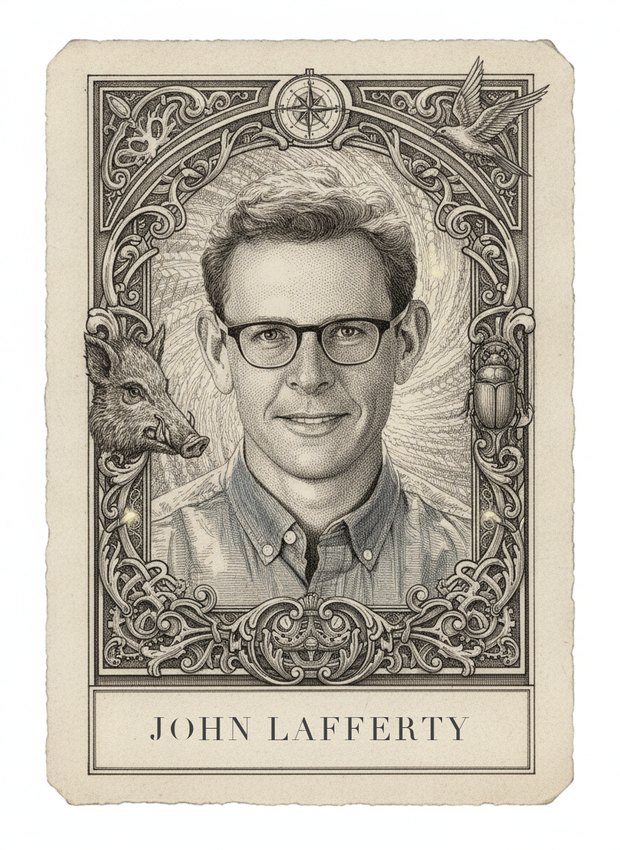
John Lafferty
Conditional random fields; statistical approaches to language
Played by RJ
Strongest on
In the mind map
The same ideas, as concepts rather than history — in John's ML knowledge map.
Life and career
John Lafferty's career traces one of the cleanest arcs in modern machine learning: from the statistical language modeling groups of industrial research, through the years when Carnegie Mellon turned machine learning into an academic department, and on to a senior chair in statistics and data science at Yale. Along the way he helped build the mathematical object that dominated applied natural language processing for roughly a decade.
He trained as a mathematician, and it shows in everything he has written. His early professional work was at IBM's Thomas J. Watson Research Center, in the orbit of the speech and language group that had committed, unfashionably at the time, to the proposition that language should be modeled statistically rather than through hand-written grammars. That group produced the noisy-channel formulation of machine translation, n-gram language modeling at industrial scale, and the maximum-entropy modeling tradition. Lafferty was part of that maximum-entropy line, co-authoring foundational work on inducing features for random field models — the question of how a model should *discover* which features of an input are worth conditioning on, rather than having them handed over by a linguist.
He moved to Carnegie Mellon, where he spent the bulk of his career, holding appointments spanning computer science, statistics, and the machine learning department that CMU established as ML's first standalone academic home. CMU in that era was an unusually good habitat for someone with Lafferty's temperament: a place where a theorist could work shoulder to shoulder with people building deployed speech recognizers and information retrieval systems, and where the statistics department was close enough to walk to. Much of his most distinctive work comes from that adjacency — problems posed by language and information retrieval, attacked with tools from convex duality, information geometry, and nonparametric statistics.
He later joined the University of Chicago, and then Yale, where he is a named professor of statistics and data science and has been closely involved in building out that university's data science presence. The move from computer science departments toward statistics departments was not a change of subject for him so much as a change of address; his research had been sitting on that border for twenty years already.
The through-line of his career is a refusal to pick a side in the statistics-versus-machine-learning quarrel. He has published algorithms that shipped in production NLP systems and minimax rate theorems for nonparametric estimators, often in the same few years, and his long collaborations — with Larry Wasserman at CMU on nonparametric methods, with David Blei on topic models, with a generation of students who went on to run their own groups — reflect a person more interested in the problem than in the tribe.
Key contributions
The contribution everyone knows is the **conditional random field**. In 2001, with Andrew McCallum and Fernando Pereira, Lafferty introduced CRFs to solve a specific and painful problem in sequence labeling. The generative alternative, the hidden Markov model, forces you to model the distribution of the observations themselves, which means you cannot casually throw in overlapping, correlated features — is this word capitalized, does it end in *-ing*, is it in a gazetteer of city names, what is the word three positions to the left — without doing violence to the model's independence assumptions. The obvious fix, a chain of locally normalized conditional models (the maximum-entropy Markov model), turns out to have a subtle and fatal defect: **label bias**. Because each transition distribution normalizes locally, states with few outgoing transitions pass their probability mass through nearly unchanged, and the model becomes reluctant to let evidence downstream override an early commitment.
The CRF fixes this by normalizing globally. You define a single undirected conditional distribution over the entire label sequence given the entire observation sequence, with the partition function summing over all label sequences. That single design decision buys you three things at once: arbitrary, overlapping, non-independent features of the input at every position; a convex log-likelihood, so training has no local optima; and exact inference by dynamic programming on the chain, since forward-backward and Viterbi carry over essentially unchanged. For the better part of a decade, CRFs were the default answer to part-of-speech tagging, named entity recognition, shallow parsing, gene-finding in biological sequences, and information extraction generally — anywhere the output is structured and the input is rich.
Lafferty's second body of work is in **information geometry applied to learning**. Rather than treating a model class as a flat parameter space, this line treats it as a Riemannian manifold with the Fisher information as its metric, and asks what algorithms look like when they respect that geometry. His work with Guy Lebanon on diffusion kernels on statistical manifolds is the cleanest example: it constructs kernels for data that are themselves distributions — multinomials, for instance, which is what a bag-of-words document is — by solving the heat equation on the appropriate manifold rather than pretending the simplex is Euclidean space. It is a characteristic Lafferty move: notice that the standard tool has an unexamined geometric assumption, and replace it with the right one.
Third, he has been a major contributor to **high-dimensional nonparametric statistics**. Nonparametric regression is famously cursed by dimension; the classical rates degrade so fast that smoothing in more than a handful of variables is hopeless. The response, developed with Wasserman and students including Pradeep Ravikumar and Han Liu, was to impose sparsity on structure rather than on coefficients. Sparse additive models (SpAM) fit a sum of one-dimensional smooth functions with a penalty that zeroes out most of them entirely, giving you the flexibility of a smoother with the variable selection of the lasso. Related work — the rodeo approach to local bandwidth selection, and the nonparanormal, which lets a Gaussian graphical model be fit after unknown monotone transformations of each variable — attacks the same target from different directions: keep nonparametric honesty, buy back tractability with structure.
Fourth, with David Blei he extended **topic modeling** beyond its original form. Latent Dirichlet allocation assumes topics are independent and static; correlated topic models replace the Dirichlet with a logistic normal so that topics can co-occur, and dynamic topic models let a corpus's topics drift over time, so you can watch a scientific field's vocabulary change across a century of journal issues. Both required real work on approximate inference, since the conjugacy that made LDA tractable is exactly what is being given up.
In battle
Lafferty's battle profile is one of the sharpest in the roster: a low mean score of about 31 across roughly a hundred problems, but a tiny handful of near-perfect scores. He is a specialist weapon, and the game rewards him accordingly.
His signature is **P085 — Label every word**, which he scores 98 on, the highest in his set and among the highest of any figure on any problem. This is not a good match; it is *the paper*. The problem describes escaping label bias by conditionally modeling an entire label sequence with global normalization and arbitrary input features, in 2001, at Carnegie Mellon. That is the CRF paper down to the venue and the year. Play him here and nothing else in the pool competes.
The rest of his dominant band is his real professional neighborhood. **P256 — The parallel text is the teacher** (90) and **P261 — A million parsed sentences** (84) both sit inside the statistical NLP tradition he came up in at IBM and extended at CMU: aligned bilingual corpora as supervision, treebank-scale statistical parsing. **P027 — Classify with 30 labels and 30,000 unlabeled** (82) draws on his semi-supervised and graph-regularization work, **P057 — The web of symptoms** (79) on graphical model structure, and **P258 — The inbox under siege** (71) on the discriminative text classification his feature-induction work anticipated. **P020 — The smooth curve, honestly** (68) is the nonparametric-regression side of his career showing up where you would predict.
The category table tells the same story: `nlp` at 50.0 across thirteen problems is his broad base, with causality and small-sample scoring high on very thin samples. But `classification` sits at only 35.5 and `perception` at 21.0 — and this is the honest weakness. A CRF is a linear model over features you designed. The entire deep learning revolution consisted of learning those features instead, and on raw perceptual problems Lafferty's toolkit is the thing that got replaced. He is the master of the last architecture before the one that won.
His true losses are cleaner still, and worth reading as a lesson in what a research identity does *not* cover. **P200 — Beat the world champion** (5) and **P198 — Program chess before the computer exists** are game-tree search and hand-built evaluation functions; nothing in probabilistic sequence labeling touches them. **P157 — The equation with no algorithm** and **P201 — The dice make it learnable** are computability and complexity-theoretic; **P245 — A computer shared by fifty** is operating systems; **P181 — Optimize for the worst case** is robust optimization. He scores 8 or below on all of them, and `games` (6.5), `systems` (8.0), and `computability` (9.0) are his floor categories. **P120 — Play the winner** (8) is the most instructive loss: adaptive clinical trial design sounds statistical, but it is sequential experimental design for causal effects, a different statistical tradition entirely from conditional modeling of structured outputs — which is exactly why Susan Murphy dominates it.
The practical lesson for a player: Lafferty is a scalpel. Deploy him on structured prediction over text and he will beat almost anyone. Deploy him broadly and his median score of 24 will bury you.