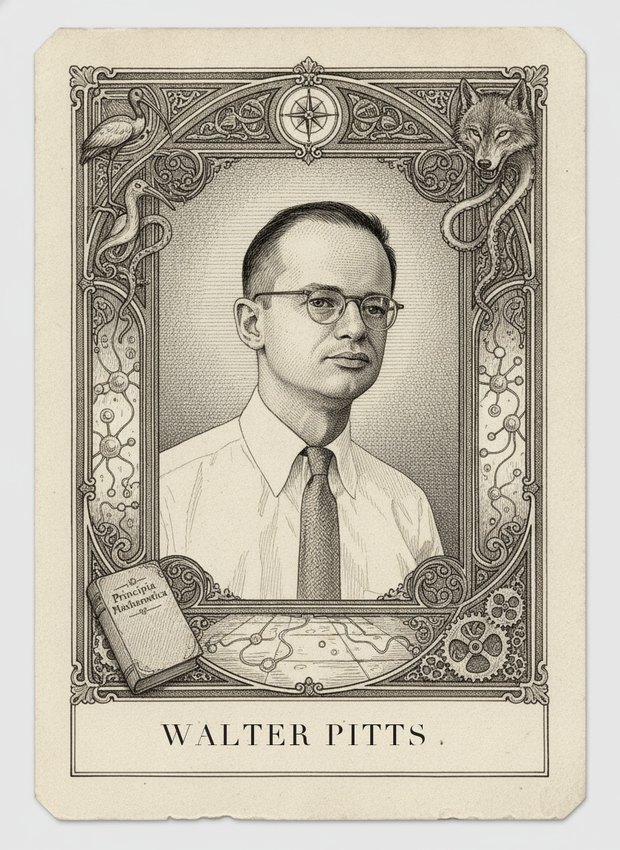
Walter Pitts
The McCulloch-Pitts neuron; logic of neural networks; self-taught prodigy
Strongest on
In the mind map
The same ideas, as concepts rather than history — in John's ML knowledge map.
Life and career
The story of Walter Pitts is the one everyone in this field half-remembers and few can tell accurately, because the accurate version is stranger and sadder than the legend. Born in Detroit in 1923 into a poor and reportedly violent household, Pitts had essentially no formal education past childhood. The often-repeated account has him hiding in a library to escape neighborhood bullies and spending three days reading Bertrand Russell and Alfred North Whitehead's *Principia Mathematica* straight through, then writing to Russell about errors he believed he had found. Whatever the embellishments in that story, the substance is not in doubt: Pitts was an autodidact of extraordinary power who arrived at the University of Chicago as a teenager with no degree, no money, and no institutional standing, and was taken seriously by some of the best logicians alive because the mathematics he produced was simply good.
At Chicago he fell in with Rudolf Carnap, the logical positivist, and with Nicolas Rashevsky's mathematical biophysics group — a small, unfashionable enterprise trying to give biology the same formal treatment physics had. There he met Warren McCulloch, a neurophysiologist and psychiatrist roughly twice his age, who took Pitts into his home. The collaboration that followed produced, in 1943, "A Logical Calculus of the Ideas Immanent in Nervous Activity," which remains one of the founding documents of both artificial intelligence and computational neuroscience. Pitts was around twenty years old.
The paper brought him into the orbit of Norbert Wiener at MIT, who regarded him as the most promising young scientist he had met and effectively adopted him intellectually. Pitts moved to MIT, joined the cybernetics circle — Wiener, McCulloch, Jerome Lettvin, Oliver Selfridge — and participated in the Macy Conferences that gave cybernetics its shape. He never took a degree; MIT is said to have offered him one, and he declined or simply failed to complete the formalities.
Then it came apart. In the early 1950s Wiener abruptly severed all contact with Pitts and McCulloch. The reasons have been reported as personal rather than scientific, involving Wiener's family, and the details remain contested; what is not contested is the effect. Pitts, who had built his life around Wiener's regard, withdrew. He drank heavily. He is reported to have burned a manuscript — a thesis on three-dimensional neural nets, the work he had spent years on — and much of his other unpublished writing. He continued to appear in the lab and to contribute to others' work, notably the celebrated 1959 paper "What the Frog's Eye Tells the Frog's Brain" with Lettvin, Maturana, and McCulloch, but he published little under his own name again. He died in 1969, at forty-six, of complications associated with alcoholism. McCulloch died a few months later.
It is worth noting the date. 1969 is the year Minsky and Papert's *Perceptrons* appeared and the neural-network winter began. The man who had proved, twenty-six years earlier, exactly what networks of neurons could represent was alive that year and took no part in the argument.
Key contributions
The 1943 McCulloch–Pitts paper does something that is easy to underrate now that it has been absorbed into the background. It proposes an idealization of the neuron — a unit that receives weighted binary inputs, sums them, and fires if the sum exceeds a threshold, with inhibitory inputs able to veto firing outright — and then treats such units as logical primitives. Under this idealization, a single unit computes a threshold function; AND, OR, and NOT fall out immediately. From there, standard results in propositional logic do the rest: networks of these units can realize any Boolean function whatsoever, and with recurrent connections carrying activity forward in discrete time steps, they can hold state. The paper's claim, stated in the language of the logic of the day, is that the activity of such nets is equivalent to propositional logic with a temporal index — and that suitably augmented, such nets have the computational power of a Turing machine.
Three things follow, and they are the reason the paper still matters. First, it made "the brain computes" a mathematically respectable statement rather than a metaphor: whatever else neurons are doing, an all-or-none firing event is formally a truth value, and a circuit of them is a proof. Second, it separated *representation* from *learning* in a way the field would later forget and painfully rediscover. McCulloch and Pitts hand-wired their networks; there is no learning rule anywhere in the 1943 paper. What they established is that the architecture class is expressive, not that anything can find the right weights. Third, it fed directly into the design of digital computers. Von Neumann's 1945 *First Draft of a Report on the EDVAC* uses McCulloch–Pitts notation explicitly to describe logical elements — the idealized neuron became, by a short path, the logic gate.
Pitts's other lasting contribution is more purely mathematical and less often read: with McCulloch, "How We Know Universals: The Perception of Auditory and Visual Forms" (1947), which asks how a network can recognize a pattern independent of its size, position, or pitch, and answers with a scheme of group-averaging over transformations. This is, in embryo, the invariance problem that convolutional architectures and equivariant networks address today — the recognition that perception requires quotienting out a symmetry group, and that a network can do this by summing a feature over the group's orbit. The frog's-eye paper he later contributed to cut against the 1943 idealization in an interesting way: the retina turned out not to be a passive logic relay but an active feature detector, computing bug-shaped-things before anything reached the brain. Pitts is reported to have found this deeply discouraging to the clean logical picture.
In battle
Pitts is the sharpest example in the roster of a figure with one towering peak and a very flat plain around it. Across his hundred problems his mean score is 14 and his median 11; eighty-four of them score at or below 20. He has exactly one problem above 70 — and it is the right one.
That problem is **XOR** (P024), where he scores 72, higher than almost anyone. The reason is precise rather than sentimental: the 1943 calculus builds an XOR network from AND, OR, and NOT units as a routine exercise, which means the *representational* answer to XOR predates Rosenblatt's perceptron by fifteen years and Minsky and Papert's critique by twenty-six. The 1969 crisis was never about whether neural networks could express parity — Pitts had settled that — but about whether a single trainable layer could, and whether deeper nets could be trained at all. Pitts owns the representational half of that question outright and forfeits the learning half completely, because his networks had no learning rule of any kind.
His other wins cluster in **computability** (mean 36) and cases where recognition is treated as a logical construction. He scores 66 on **The memory that completes the pattern** (P242), where recurrent threshold circuits holding state are directly on point, and 49 on **Three machines, one class** (P155) — equivalence of computational models is his native territory, since the 1943 paper's punchline is precisely such an equivalence. He is competitive on **Let the machine find the proof** (P195), **Solve the impossible formula** (P187), **The equation with no algorithm** (P157), **Prove the program correct** (P048), and **Every interesting property is undecidable** (P156). All of these reward someone who thinks in propositional logic and Turing-equivalence, which is the only way Pitts thinks.
Where he collapses is everywhere continuity, noise, or data appears. His worst scores — 3 out of 100 — are on **Sample from the impossible posterior** (P212), **The posterior at web scale** (P213), **The paradox in the admissions data** (P214), **The therapy the trial reversed** (P215), **Calculus for a jagged path** (P216), and **How high must the dike be?** (P217). Read that list as a diagnosis. Bayesian computation, causal inference from observational data, stochastic calculus, and extreme value theory all require reasoning about probability distributions, and the McCulloch–Pitts neuron is aggressively deterministic: all-or-none, threshold, no noise model, no error term, no notion of a sample. His category means make the same point quantitatively — regression 4.5, optimization 4.0, information 7.0. He has no statistical machinery whatsoever.
So the strategy against Pitts is simple and the strategy with him is narrow. Play him on questions about what a circuit *can in principle compute*, on decidability, on model equivalence, on the expressive power of layered architectures. Do not play him on anything involving a dataset, a prior, a confounder, or a real-valued gradient. His era gave him a beautiful theorem about representation and left him with nothing to say about learning, and the matrix reflects that division almost perfectly.