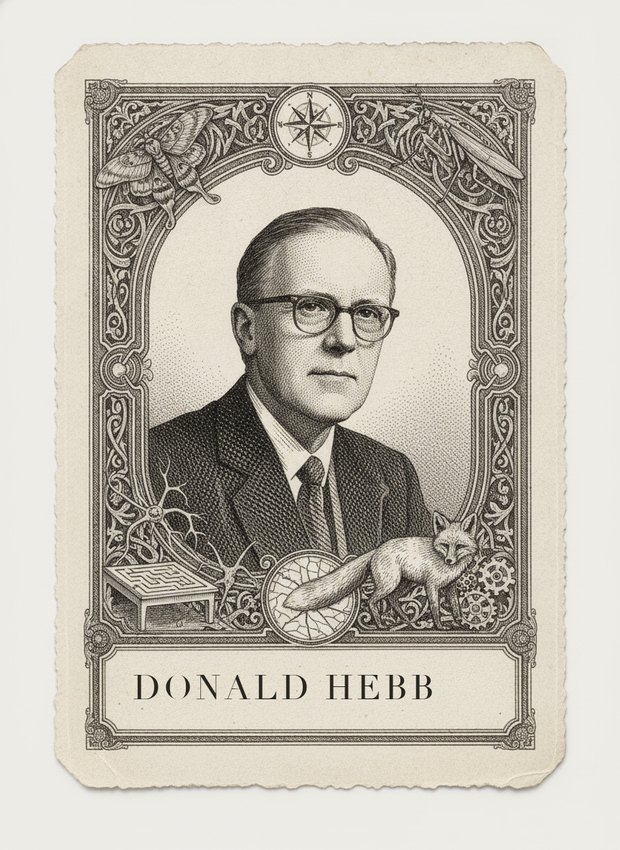
Donald Hebb
Hebbian learning: cells that fire together wire together
Strongest on
In the mind map
The same ideas, as concepts rather than history — in John's ML knowledge map.
Life and career
Donald Olding Hebb wanted to be a novelist. Born in Chester, Nova Scotia, in 1904 to two physicians, he took his first degree at Dalhousie with the vague intention of writing fiction, and spent his twenties doing almost everything else: schoolteaching in Quebec, farm labour, a stint as a labourer out west. He came to psychology late and sideways, reading Freud and then Pavlov and deciding that the interesting question was not the content of mental life but its physical implementation.
He entered graduate work at McGill under Boris Babkin, a former student of Pavlov's, and then found the person who would shape him: Karl Lashley, the great American physiological psychologist. Hebb followed Lashley from Chicago to Harvard and took his doctorate there in 1936, working on rats raised in darkness — an early attack on the question of how much of perception is built in and how much is learned. This period of his life was also marked by personal loss; his first wife died young, and the biographical accounts describe a man who came to his career through repeated interruption.
The 1930s and 1940s gave Hebb an unusual sequence of empirical vantage points, and it is worth listing them because his theory is a synthesis of all of them. From 1937 he worked with the neurosurgeon Wilder Penfield at the Montreal Neurological Institute, studying patients who had undergone brain surgery — and was struck by how little measurable intelligence loss followed even substantial removals of cortex, especially in adults. At Queen's University he developed, with Kenneth Williams, the Hebb–Williams maze, a standardized battery for measuring animal intelligence that is still used. From 1942 he worked with Lashley again at the Yerkes Laboratories of Primate Biology in Florida, studying chimpanzee emotion and temperament, where he became convinced that fear and other emotional responses depend on prior experience in ways that simple stimulus–response accounts could not handle.
In 1947 he returned to McGill as a professor, became chair of psychology the following year, and turned the department into one of the strongest in North America. The 1949 book *The Organization of Behavior: A Neuropsychological Theory* came out of that synthesis, and it changed the field. Hebb served as president of the American Psychological Association in 1960 and later held senior administrative office at McGill, including its chancellorship.
One episode belongs in an honest account. In the early 1950s Hebb's McGill lab ran sensory-deprivation experiments — student volunteers in cubicles with translucent goggles, cotton gloves, and masking noise — funded by the Canadian Defence Research Board, motivated in part by Cold War anxiety about the interrogation of prisoners. The scientific result was striking: prolonged reduction of patterned stimulation produced disorientation, cognitive impairment, and in some cases hallucination, which Hebb read as evidence that the brain requires a continuous stream of input to maintain organized function. The work was also later of interest to agencies pursuing coercive interrogation techniques, a use Hebb himself did not endorse and publicly regretted the association with. It is part of the record and part of why the mid-century entanglement of psychology and defense funding is worth teaching.
Hebb retired to Nova Scotia and died there in 1985.
Key contributions
**The Hebbian postulate.** The famous passage in *The Organization of Behavior* states, in essence, that when an axon of cell A is near enough to excite cell B and repeatedly or persistently takes part in firing it, some growth process or metabolic change takes place in one or both cells such that A's efficiency in firing B is increased. The slogan version — cells that fire together wire together — was coined later by others, but it is a fair compression.
Note what the postulate is and is not. It is a *local*, *correlational*, *unsupervised* rule: the change at a synapse depends only on the activity of the two cells it connects, with no reference to any global error signal, target, or reward. Formalized, it is $\Delta w_{ij} = \eta\, x_i x_j$ — the outer product of pre- and post-synaptic activity. Hebb himself wrote no equation; the mathematics is entirely the work of those who came after.
The rule's consequences run through decades of computational neuroscience and machine learning. Unmodified, it is unstable — weights grow without bound — which motivated normalized variants, most importantly Oja's rule, which adds a decay term and causes a single linear unit to converge to the principal eigenvector of the input covariance. This is the crucial theoretical fact for a machine-learning audience: **Hebbian learning is principal component analysis performed by a network.** A correlational local rule, iterated, extracts the directions of maximal variance in the input. Sanger's generalized Hebbian algorithm extends this to the full set of principal components. Competitive learning, self-organizing maps, independent component analysis learning rules, and the sparse-coding schemes that recover Gabor-like receptive fields from natural image patches are all in this lineage.
Hopfield networks are the other major descendant. The weight matrix that stores a set of patterns $\{\xi^\mu\}$ is $W = \sum_\mu \xi^\mu (\xi^\mu)^\top$ — literally a sum of Hebbian associations — and the network then performs content-addressable recall by descending an energy function. The storage rule is Hebb's; the energy formulation, the spin-glass analysis, and the capacity bound of roughly $0.14N$ patterns are Hopfield's and Amit–Gutfreund–Sompolinsky's.
**Cell assemblies and phase sequences.** Hebb's larger theory was that repeated co-activation binds neurons into *cell assemblies* — diffuse, reverberating groups that can sustain activity after the stimulus is gone — and that sequences of assemblies, *phase sequences*, constitute thought. This gave him a two-timescale memory theory: short-term memory as reverberating activity in a loop, long-term memory as structural synaptic change consolidated from it. That distinction, and the notion of a distributed representation in which a concept is a pattern of activity across many cells rather than a single cell, is Hebb's most underappreciated contribution and is the conceptual root of distributed representations in connectionism.
**Experience and development.** Hebb argued forcefully that early experience shapes neural organization — his enriched-environment experiments, in which rats raised as household pets outperformed cage-raised rats on later maze learning, are the foundation of the enrichment literature. His A/B distinction between innate intellectual potential and observed intelligence, and his arousal theory positing an optimal intermediate level of arousal for performance, were both influential in psychology.
Empirically, the postulate was vindicated decades later. Long-term potentiation, discovered by Bliss and Lømo in the early 1970s, and the NMDA receptor's role as a coincidence detector requiring both presynaptic glutamate and postsynaptic depolarization, are about as close to a molecular implementation of Hebb's rule as one could ask for. Spike-timing-dependent plasticity refined it further, adding the causal asymmetry Hebb's "takes part in firing it" already implied.
In battle
Hebb has the narrowest and lowest profile of anyone in this set, and the matrix is unsparing: 100 problems, mean 11.6, median 8, **zero** dominant cells, only two problems above 70, and eighty-nine at 20 or below. This is not a defect of the scoring — it is an accurate statement about what a single unsupervised local learning rule, proposed verbally in 1949 by a psychologist, can be asked to do.
His only real categories are **perception** (56.7 across 3 problems) and **high-dim** (46.5 across 2). His two best cells are **P242 — The memory that completes the pattern** (78) and **P288 — Let the images choose the basis** (78). The first is the Hopfield network, where, as the matrix explains, every weight matrix is mechanically a sum of Hebbian associations — he authored the storage mechanism, and is discounted only because the energy framing and capacity mathematics are entirely Hopfield's. The second is PCA/eigenbasis learning from images, which is exactly what a normalized Hebbian rule computes. **P232 — The pattern survives the shift** (62) rewards his cell-assembly account of invariant recognition, though without any of the machinery of convolution or weight sharing.
After those three, he falls off a cliff. **P229 — The room with no reward** (35) gives him partial credit for intrinsic motivation and exploration, an idea his arousal theory gestures at. **P024 — XOR** (34) is a telling number: Hebbian learning cannot solve XOR, because a purely correlational local rule has no mechanism for assigning credit through a hidden layer. That is the central structural limitation of his contribution and the reason backpropagation exists. **P237 — Replace the acoustic model** (30) and **P053 — Teach the machine checkers** (29) are supervised and reward-driven respectively, and Hebb specified neither an error signal nor a reward signal.
The floor is uniform and total: 2–3 on **P217 — How high must the dike be?**, **P216 — Calculus for a jagged path**, **P215 — The therapy the trial reversed**, **P214 — The paradox in the admissions data**, **P213 — The posterior at web scale**, and **P211 — Roll the dice at Los Alamos**. His **regression** (4.0), **optimization** (4.5), **experimental-design** (5.0), **causality** (8.3 across 18), and **computability** (6.8) averages are near-zero. Hebb was a neuropsychologist who did not do mathematics; there is no bridge from a synaptic plasticity postulate to extreme value theory, stochastic calculus, confounding, or Monte Carlo, and the matrix refuses to invent one.
The way to play Hebb is to understand what he is: a very sharp key for a very small number of locks. Unsupervised association, content-addressable memory, learning a basis from correlational structure, biological plausibility. Anywhere a target, a reward, a gradient through depth, a sampling distribution, or an algorithm's cost is the crux, he has nothing — and the pedagogical value of his profile is precisely in seeing how much of modern learning theory consists of supplying the things Hebb's rule leaves out.