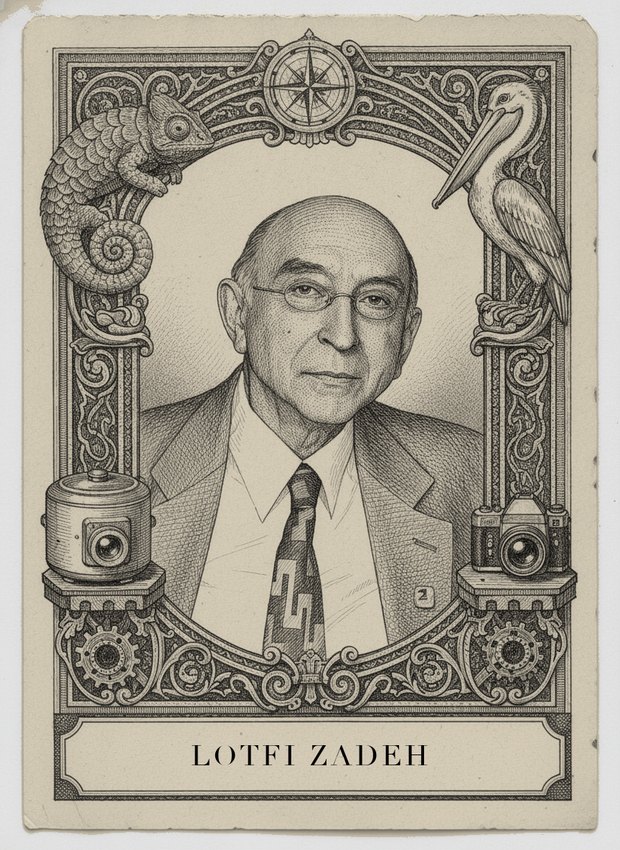
Lotfi Zadeh
Fuzzy logic and fuzzy sets
Strongest on
In the mind map
The same ideas, as concepts rather than history — in John's ML knowledge map.
Life and career
Lotfi Aliasker Zadeh was already a distinguished systems theorist with a secure reputation when, at forty-four, he published a paper that a good fraction of his profession considered a mistake. He spent the remaining fifty-two years of his life defending it, and in the meantime it was cited more than almost any other engineering paper of the century and ended up controlling subway trains, washing machines, and camera autofocus systems.
He was born in Baku in 1921, in Soviet Azerbaijan, to an Iranian Azerbaijani journalist father and a Russian Jewish pediatrician mother. The family moved to Tehran in 1931, and Zadeh was educated at Alborz College, an American Presbyterian mission school, which gave him English and an early orientation toward the United States. He took an electrical engineering degree at the University of Tehran in 1942 — placing near the top of the national entrance examination — and emigrated to the United States in 1944.
He took a master's at MIT in 1946 and a doctorate at Columbia in 1949, working under John Ragazzini. This is the part of his career that gets forgotten and should not: Zadeh's pre-fuzzy work was serious mainstream systems theory. With Ragazzini he developed the z-transform analysis of sampled-data systems — the discrete-time transform every digital signal processing course teaches — and extended Wiener's filtering theory to finite observation intervals with polynomial trend components. His 1963 book with Charles Desoer, *Linear System Theory: The State Space Approach*, was one of the texts that established state-space methods as the standard language of control, and Zadeh is credited with much of the currency of the phrase "state space" itself. He was, in short, a fully accredited member of the community that would later be most skeptical of him.
He taught at Columbia, becoming a full professor in 1957, and in 1959 moved to Berkeley, where he stayed for the rest of his life. He chaired the electrical engineering department from 1963 to 1968, and in that role was central to establishing computer science at Berkeley and to the merger that produced the EECS department. Berkeley graduate students should note that the fuzzy sets paper was written in an office in Cory Hall.
"Fuzzy Sets" appeared in *Information and Control* in 1965. The reaction split sharply along disciplinary lines. Engineers, particularly in Japan and later Europe, took it up enthusiastically. Probabilists and statisticians largely did not, and the objection was foundational rather than aesthetic: Dennis Lindley, Peter Cheeseman, and others argued that probability theory, given the Cox axioms, is the unique consistent calculus for reasoning under uncertainty, and that anything fuzzy logic could do, probability could do with a better-justified semantics. Zadeh's reply was that they were answering a different question — that vagueness (is this person *tall*?) is not the same phenomenon as uncertainty (will it rain?), and that a boundary can be genuinely indeterminate rather than merely unknown. The debate ran for decades and was, at times, unpleasant.
The vindication, such as it was, came from industry rather than academia. Japanese engineers in the 1980s built fuzzy controllers into real products: the Sendai subway's automatic train operation, Matsushita washing machines, Canon autofocus, rice cookers and air conditioners. For a period "fuzzy" was a consumer marketing term in Japan. Western academics remained divided.
Zadeh kept extending the framework — fuzzy algorithms, linguistic variables, possibility theory, granular computing, computing with words, and late in life Z-numbers. He coined the umbrella term "soft computing" for the family of methods that trade precision for tractability and robustness. He received the IEEE Medal of Honor in 1995, worked at Berkeley into his mid-nineties, died there in 2017 at 96, and was given a state funeral in Baku.
Key contributions
**Fuzzy sets.** The definition is one line. A classical subset $A \subseteq X$ is specified by an indicator $\chi_A: X \to \{0,1\}$. A fuzzy set replaces this with a membership function $\mu_A: X \to [0,1]$, where $\mu_A(x)$ is the *degree* to which $x$ belongs to $A$. "Tall," "warm," "approximately 5" become sets with graded boundaries.
The consequential part is the algebra. Zadeh defined union, intersection, and complement as $\max$, $\min$, and $1 - \mu$. Note what this is *not*: it is not probability. $\mu_{A \cap B} = \min(\mu_A, \mu_B)$ has no independence assumption in it, and $\mu_{A \cap A^c}$ is generally nonzero — the law of excluded middle fails, deliberately, because something can be partly tall and partly not-tall in a way that a coherent probability cannot be partly true and partly false. Later work generalized min/max to arbitrary t-norms and t-conorms (product/probabilistic sum, Łukasiewicz, and others), giving a family of logics of which Zadeh's is one member.
**The extension principle and fuzzy arithmetic.** Given a function $f: X \to Y$ and a fuzzy set on $X$, the extension principle induces a fuzzy set on $Y$ by taking, for each $y$, the supremum of $\mu_A(x)$ over the preimage. This lets you push fuzzy quantities through ordinary functions and gives fuzzy arithmetic — a calculus for propagating imprecision that is closely related to interval arithmetic with graded intervals.
**Linguistic variables and approximate reasoning.** The 1973 paper "Outline of a New Approach to the Analysis of Complex Systems and Decision Processes" is arguably as important as the 1965 one. A *linguistic variable* takes values that are words — temperature is {cold, cool, warm, hot} — each word denoting a fuzzy set, with *hedges* (very, somewhat, more or less) acting as operators on membership functions. Rules take the form IF temperature IS warm AND humidity IS high THEN fan-speed IS fast, and the compositional rule of inference determines the output fuzzy set from partially matching inputs. Because a real input activates several rules to varying degrees, the system interpolates smoothly between rules rather than switching discontinuously.
**Fuzzy control.** Mamdani and Assilian's 1975 steam-engine controller turned this into engineering practice: fuzzify inputs, evaluate all rules in parallel, aggregate the output sets, then *defuzzify* — usually by taking the centroid — to get a crisp actuator command. Takagi and Sugeno's 1985 variant made rule consequents linear functions of the inputs rather than fuzzy sets, which for a machine-learning reader is worth recognizing precisely: a Takagi–Sugeno system is a set of local linear models with smooth soft gating, i.e. a mixture of experts with hand-specified gates. ANFIS, developed by Jyh-Shing Jang at Berkeley, made those gates learnable by gradient descent, closing the loop with neural networks.
**Possibility theory.** Zadeh's 1978 proposal that a fuzzy set induces a *possibility distribution*, distinct from a probability distribution and satisfying $\Pi(A \cup B) = \max(\Pi(A), \Pi(B))$ rather than additivity. This connects to Dempster–Shafer belief functions and to imprecise probability, and is the most philosophically developed part of his programme.
The honest assessment for a modern audience: fuzzy sets provide a genuinely useful engineering language for encoding expert knowledge as smooth interpolating rules, and fuzzy c-means clustering (Dunn and Bezdek's soft-assignment generalization of k-means) is a real and widely used algorithm whose soft responsibilities anticipate the E-step of EM. But the framework has no learning theory, no notion of a sampling distribution, and no calibration story — membership functions are authored, not estimated — and where data is plentiful, statistical methods have generally displaced it.
In battle
Zadeh's computed profile is the most uniformly flat in this set, and it is worth stating plainly: 100 problems, mean 15.4, median 14, range 3 to 48. **Zero** dominant cells, **zero** problems above 70, and seventy-nine at 20 or below. He never wins a battle outright anywhere on this board.
His best categories are **nlp** (28.0), **optimization** (22.5), **rl** (22.5), and **experimental-design** (21.0), none of which is meaningfully strong. **classification** sits at 16.1 across seventeen problems and **causality** at 13.9 across eighteen.
His single highest cell is **P047 — The robot in the warehouse** at 48, and the matrix's explanation of it is the most interesting paragraph on his sheet because it argues *upward*: Zadeh has a stronger claim here than his reputation suggests, because fuzzy control became a genuinely fielded real-time technology — the Sendai subway, appliance controllers, and a real literature of fuzzy obstacle avoidance and wall following on mobile robots — precisely because rule bases evaluate in microseconds and degrade gracefully under sensor noise. That is closed-loop control on real hardware, which most of his contemporaries on this board cannot claim. The ceiling, the explanation continues, is that fuzzy control handles the *reactive* layer only: steer left when the obstacle is near-left. It does not do deliberative task planning, goal decomposition, or replanning, and the rule bases are hand-authored and do not learn. A reactive-layer specialist, honestly mid-table.
Below that his best cells run 30–36 and are all cases of partial credit for graded reasoning: **P261 — A million parsed sentences** (36), **P057 — The web of symptoms** (35, expert-system diagnosis, where fuzzy MYCIN-style certainty factors were genuinely deployed), **P056 — The doctor's update** (33, which is really Bayes's problem and where Zadeh is the alternative that lost), **P029 — The tilted scan** (32), **P045 — Tune the un-differentiable** (30), **P146 — The tree you can read** (30, interpretable models — fuzzy rule bases are legitimately interpretable, but decision trees are not his), and **P218 — Thirty percent chance of rain** (30, probability calibration, where his position is again the losing side of a foundational argument).
The floor is entirely statistical: **P216 — Calculus for a jagged path** (3), **P213 — The posterior at web scale** (3), **P212 — Sample from the impossible posterior** (3), **P217 — How high must the dike be?** (4), **P215 — The therapy the trial reversed** (4), and **P214 — The paradox in the admissions data** (4). His **regression** (6.5), **information** (7.5), **testing** (9.0), and **networks** (9.0) averages are near zero. The reason is structural rather than accidental: fuzzy set theory is a calculus of *vagueness* — of predicates without sharp boundaries — and every one of those problems is about *uncertainty* under a probability model. Zadeh spent his career insisting those are different problems, and the matrix, in effect, agrees with him and then scores him only on the one he chose.
The pedagogical value of playing Zadeh is precisely that he cannot win. His profile is a compact argument about the difference between a framework with an enormous citation count and a framework that answers the questions this board asks. He built a genuinely useful engineering language, fielded it in real products, and left behind almost nothing that competes on problems where data, estimation, and inference are the crux.